DISPENSATIONAL TRUTH
Pleroma
By Charles H. Welch
Of all the terms used in dispensational truth, the Pleroma by its very nature and meaning is surely one of the most comprehensive. Accordingly, we are setting ourselves no restrictions on space in this Analysis, and have introduced into this volume a full-paged illustration. We commend this theme to every lover of the Word, and particularly to those who have the responsibility of teaching others.
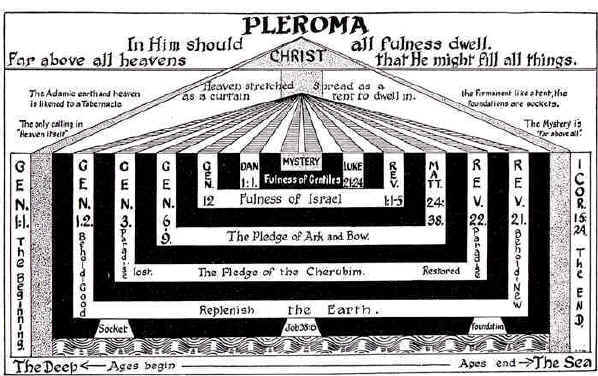
The Chart is so mounted that it can be left open for reference while the article is read. (See back of book).
THE PLEROMA
(1) INTRODUCTION AND CHART
THE problem of the ages is the problem of the presence of evil, of the apparent necessity for suffering, yet with a baffled feeling of frustration. Men like Job and Asaph and books like Ecclesiastes, ventilate this feeling, but the consciousness of redeeming love, enables the believer to trust where he cannot trace. The present study is set forth with an intense desire, to borrow the words of Milton "to justify the ways of God with men", to show that there is a most gracious purpose in process, and that there are indications of that purpose in sufficient clearness to enable the tried believer to say with Job "when He hath tried me, I shall come forth as gold".
In the present study, we commence with the primary creation of Genesis 1:1 which is followed by the "rent" or gap of Genesis 1:2, and conc1ude with the creation of the new heavens and new earth of Revelation twenty-one, which, according to Peter, is ushered in by a convulsion of nature similar to the condition described as "without form and void" at the beginning.
By observing the parallel between the word of Ephesians 1:4 and 2 Timothy 1:9 we are able to show that "the ages" commence with the reconstruction of the earth in Genesis 1:3. What follows is a series of "fillings" in the persons of men like Adam, Noah, Abraham, and Nebuchadnezzar, with the economies associated with them, but all such are provisional, failing and typical only, and they carry the unfolding purpose on to "the fulness of time" when "the Seed should come to Whom the promises were made". Adam was but a "filling", he was not "the fulness", that title belongs only to the Lord Jesus Christ Himself. The only company of the redeemed who are themselves called "the fulness" is the Church of the Mystery, the church of "heavenly places", the church which is most closely associated with the seated Christ.
Two words found in Matthew 9:16 must ever be kept together in the course of this study, they are the words "fulness", and "fuller". We shall see presently that God is preparing during the ages, as it were a piece of "fulled" cloth, so that at last there may be a perfected universe, the "rent" of Genesis 1:2 healed, and "God all in all". Fulling involves several processes, most of them drastic and rigorous.
"Clooth that cometh fro the wevying is nought comely to were til it be fulled under foot" (piers Plowman).
Nitre, soap, the teasle, scouring and bleaching processes at length make the shrunken c10th "as white as snow" (Mark 9:3). We can say, therefore, concerning the problem of the purpose of the ages "no fulness without fulling". We do most earnestly desire that consummation, when the Son of God shall deliver up to the Father a perfected Kingdom with every vestige of the "rent" of Genesis 1:2 entirely gone. We do most ardently desire to be found in that day, as part of that blessed pleroma or fulness, but we must remember that every thread that goes to make the "filling" will have passed through the "fuller's" hands, "fulled under foot" must precede being "far above all".
At the beginning of this volume the reader will find a chart, which endeavours to set forth the way in which the Divine purpose of the Fulness is accomplished. At either end of the chart stand "the beginning" and "the end", the black division that immediately follows the former representing the catastrophe of Genesis 1:2, "without form or void"; the black division that immediately precedes the consummation represents the corresponding state of dissolution indicated in Isaiah 34:4 and 2 Peter three leading up to 1 Corinthians 15 :24-28. Running along the bottom of the chart is "the deep" that was the vehic1e of judgment in Genesis 1:2 and that which is to pass away at the end, for John says, "and there was no more sea" (Rev. 21 :1). By comparing Ephesians 1:4, "before the foundation of the world" with 2 Timothy 1 :8-9, "before the world began (literally, before age times)" we have the start and the finish of the ages indicated.
What follows is a series of "fillings" rather than a fulness. Adam, Noah, Abraham, Nebuchadnezzar are but "stop-gaps", types and shadows, pointing on. The fulness of time (Gal. 4:4) did not come until4,OOO years after Adam and the fulness of the times (seasons) will not come until the day which is about to dawn ushers in the glory that will be revealed, when all things in heaven and on earth will be gathered together under the Headship of Christ.
Not until we reach the dispensation of the Mystery do we come to any company of the redeemed which constitute a "fulness", and there we read of the Church which is His Body, "the FULNESS of Him, that fi1leth all in all" (Eph. 1:23). The fulness of the Godhead dwells bodily in Christ, and the heavenly places, far above all, with which both the seated Christ, and His Church are associated, is a sphere untouched by the catastrophe of Genesis 1:2. Those heavenly places are where Christ sits far above all heavens (Eph. 4:10), that is, far above the temporary heaven called "the firmament" which is likened to a spread-out curtain. This "tabernac1e", characteristic of the Adamic earth, is of extreme importance; it places the whole purpose of the ages under a redeeming regis, and the reader is advised to give the artic1e which deals with this aspect careful attention.
As these studies proceed, we shall turn aside to consider various themes that bear upon the main subject, but unless that main subject is already held before the mind, we may sometimes "not see the wood for the trees". A reference back to the chart at the commencement of each section might be wise, and to enable the reader to see at the beginning the course we follow, we conc1ude this introduction with a conspectus of the artic1es that follow:
- Some lessons taught by the parable of the "patch" with an answer to the question "are there gaps in the outworking of the "divine purpose?"
- Creation, its place in "the purpose", in which the purport of the words "in (the) beginning" are considered.
- The first "gap". "Without form and void".
- The present creation, a tabernacle.
- The testimony of Peter to the days of Noah. This is a new approach to a matter of importance involving the true intention of 2 Peter three.
- Paradise lost and restored.
- The filling up of the nations (Genesis 48:19. Rotherham).
- The fulness of the Gentiles (Romans 11 :25).
- The title "Head", and its relation to the "Fulness".
- The fulness of the seasons.
- All the fulness of God.
- All the fulness of the Godhead. Bodily-wise
(2) SOME LESSONS TAUGHT BY THE PARABLE OF THE "PATCH"
To the reader who has travelled so far, we trust the principle of Right Division needs neither introduction nor commendation. Its recognition underlies every article that has been printed in these pages, and determines both the Gospel we preach, the Church to which we belong, and the hope that is before us. Dispensational Truth is not confined to one aspect or phase of the Divine purpose, for every dealing of God with man, whether under law or grace, whether with saint or sinner, has its own dispensational colouring which is inherent to its teaching and is in no wise accidental. Much has yet to be written and presented along these suggestive and attractive lines of study, but the particular application of this principle, now before us, focuses the reader's attention upon one thing, namely, that while in the mind of God the whole purpose of the ages is seen as one and its end assured, in the outworking of that purpose, the fact that moral creatures are involved, creatures that can and alas do exercise their liberty to disobey as well as to obey the revealed will of God, has had an effect upon the manifest unfolding of the purpose of the ages.
This is seen as a series of "gaps" and "postponements" which are filled by new phases and aspects of the purpose until at length He Who was once "All" in a universe that mechanically and unconsciously obeyed, will at length be "All in all" in a universe of willing and intelligent creatures, whose standing will not be that of Creation and Nature, but in Redemption and Grace.
In this section we can do little else than indicate the presence of these "gaps" and consider the terms that are employed in the Hebrew of the O.T. and the Greek of the N.T. and of the LXX. The well-known example of the Saviour's recognition of a "gap" in the prophecy of Isaiah sixty-one must be repeated for the sake of completeness and for the value of its endorsement.
We learn from the fourth chapter of Luke's Gospel, that the Lord attended the service at the Synagogue at Nazareth, and apparently, after the reading of the law by the official reader of the Synagogue, He stood up "for to read" the Haphthorah, or the recognized portion from "the Prophets" that was appointed for the day. He found the place, and commenced to read from Isaiah sixty-one. Now it is laid down by Maimonides that:
"He that reads in the prophets, was to read at least one and twenty verses" ,
but he allowed that if "the sense" be finished in less, the reader was under no necessity to read so many. Even so, it must have caused a deal of surprise to the congregation then gathered, for Christ to read but one verse and one sentence of the second verse, shut the book, and sit down. He did so because "the sense" was indeed finished in less than twenty-one verses. He was about to focus attention upon one aspect of His work, and said:
"This day is this Scripture fulfilled in your ears" (Luke 4:21).
The sentence with which the Saviour closed His reading of Isaiah sixty-one was "to proclaim the acceptable year of the Lord". The next sentence, separated in the A.V. by but a comma reads "and the day of vengeance of our God" yet that comma represents a "gap" of at least nineteen hundred years, for the days of vengeance are not referred to until in Luke 21:22 when the Second Coming and the end of the age is at hand. This passage we have examined in the article DIVISION.
The recognition of some such gap is important when reading passages like 1 Peter 1:11, or the quotation of Joel 2:28-32 in Acts two. Peter, who was a minister of the circumcision, refers to the testimony of the prophets, as though "the sufferings of Christ and the glories that should follow" had no interval of centuries between them. The outpouring of the Spirit on the day of Pentecost is linked with the blood and fire and vapour of smoke that usher in the great and notable day of the Lord, even though Pentecost took place nineteen hundred years ago and the day of the Lord has not yet come. (See PENTECOST.)
We shall discover that the whole purpose of the ages is a series of "gaps" each filled by a succeeding dispensation, which in its turn lapses, until the central dispensation, that of the Mystery, is reached, which, though it has had a central period of darkness and ignorance yet is not succeeded by any other, as the other dispensations have been. All that follow the Mystery are resumptions of the dispensations which had come to a temporary halt.
This peculiar and central dispensation is occupied by the Church, which alone of all companies of the redeemed is called "the fulness of Him that filleth all in all" (Eph. 1:23).
The word translated fulness is the Greek pleroma, and its first occurrence in the N.T. places it in contrast with a "rent" or a "gap". The two references are:
"No man putteth a piece of new cloth unto an old garment, for that which is put in to fill it up taketh from the garment, and the rent is made worse" (Matt. 9:16).
"No man also seweth a piece of new cloth on an old garment; else the new piece that filled it up taketh away from the old, and the rent is made worse" (Mark 2:21).
The parallel passage in Luke is Luke 5:36 which must be added, though it does not use the word pleroma.
"No man putteth a piece of a new garment upon an old; if otherwise, then both the new maketh a rent, and the piece that was taken out of the new agreeth not with the old" (Luke 5 :36).
The words that call for attention are:
"That which is put in to fill up". This is the translation of the Greek pleroma a word of extreme importance in the epistles, and there translated "fulness". In contrast with this "fulness" is the word "rent" which in the Greek is schisma. The word translated "new" in Matthew 9:16, and in Mark 2:21 is agnaphos, not yet fulled, or dressed, from gnapheus, a fuller. (See NEW.)
In place of "put into" or "put upon" used in Matthew 9:16 and Luke 5:36, we find the word "to sew on", epirrhapto employed in Mark 2:21. One other word is suggestive, the word translated "agree" in Luke 5:36. It is the Greek sumphoneo. Now as these terms will be referred to in the course of the following exposition, we will take the present opportunity of enlarging a little on their meaning and relationship here, and so prepare the way.
Pleroma. This word which is derived from pleroo "to :fill" occurs seventeen times in the N.T. Three of these occurrences occur in Matthew and Mark, the remaining fourteen occurrences are found in John's Gospel and in Paul's epistles. It is noteworthy that the word pleroma "fulness" is never used in the epistles of the Circumcision. When Peter spoke of the problem of the "gap" suggested by the words, "where is the promise of His coming?" he referred his readers to the epistles of Paul, who, said he, deals with this matter of longsuffering and apparent postponement and speaks of these things (2 Pet. 3:15,16).
The word pleroma is used in the Septuagint some fifteen times. These we will record for the benefit of the reader who may not have access to that ancient translation. 1 Chronicles 16:32, "Let the sea roar and the fulness thereof". So, Psalm 96:11, 98:7. "The earth is the Lord's and the fulness thereof" Ps. 24:1, so with slight variations, Psalm 50:12; 89:11. In several passages, the fulness, or "all that is therein" is set over against flood or famine, as Jeremiah 8:16; 47:2, Ezek. 12:19; 19:7, and 30:12.
Some of the words used in the context of these Septuagint references are too suggestive to be passed over without comment.
Instead of a "time of healing" we find "anxiety", the land "quaking", "deadly serpents" and a "distressed heart" (Jer. 8:15-18).
Again, in Jeremiah 47:2 (29:2 in the LXX), we have such words of prophetic and age-time significance as "an overflowing flood" Greek katakluzomai, kataklusmos and variants, a word used with dispensational significance in 2 Peter 2:5 and 3:6, and preserved in the English "cataclysm", a word of similar import to that which we have translated "the overthrow" of the world. The bearing of 2 Peter two on this "gap" in the outworking of the purpose of the ages, will be given an examination here.
In the context of the word "fulness" found in EzekieI12:19, we have such words as "scatter" diaspeiro, a word used in James 1:1 and in 1 Peter 1:1 of the "dispersed" or "scattered" tribes of Israel, also the word "waste", which calls up such passages of prophetic import as Isaiah 34:10,11, and Jeremiah 4:23-27 where the actual words employed in Genesis 1:2 are repeated.
The pleroma or "fulness" is placed in direct contrast with desolation, waste, flood, fire, scattering, and a condition that is without form and void. Schisma, the word translated "rent" in Matthew 9: 16, is from schizo which is used of the veil of the temple and of the rocks that were "rent" at the time of the Saviour's death and resurrection. Agnaphos, translated "new", refers to the work of a "fuller", who smooths a cloth by carding. The work of a fuller also includes the washing and scouring process in which fuller's earth or fuller's soap (Mal. 3:2, Mark 9:3) is employed. A piece of cloth thus treated loses its original harshness, and more readily "agrees with" the cloth that has been more often washed.
The whole process of the ages is set forth under the symbol of the work of a fuller, who by beating and by bleaching at length produces a material which is the acme of human attainment, for when the Scriptures would describe the excellent glory of the Lord, His garments are said to have been "exceeding white as snow, so as no fuller on earth can white them" (Mark 9:3). So too, the effect upon Israel of the Second Coming is likened to "a refiner's fire and like fuller's soap" (Mal. 3 :2). It is this "fulled" cloth that makes the "fulness", although there is no etymological connexion between these like-sounding words.
There is another word translated "new", kainos, which has the meaning of "fresh, as opposed to old", "new, different from the former", and as a compound, the meaning "to renew". It is this word that is used when speaking of the new covenant, the new creation, the new man, and the new heaven and earth. We shall have to take this into account when we are developing the meaning and purpose of the "fulness". The Septuagint version of Job 14:12 reads in place of, "till the heavens be no more", "till the heavens are unsewn"! The bearing of this upon the argument of 2 Peter three, the present firmament, and the fulness, will appear more clearly as we proceed.
Finally, we have the word sumphoneo "to agree". Sumphonia is translated "music" in Luke 15:25, and of course is the Greek original of our word Symphony. In Ecclesiastes 7:14, the word is used with a rather different meaning than "agreement". "In the day of prosperity be joyful, but in the day of adversity consider: God also hath set the one over against the other, to the end that man should find nothing after him". This God will do when at the end of the ages He sets His Peace over against the present conflict, and symphony takes the place of discord.
The presence of so many terms of age-importance in the homely parable of the patching of a torn garment is wonderful in itself, but the wonder grows when we remember that He, in Whom dwells all the pleroma of the Godhead bodily, used this profound and significant term in such a homely and lowly connexion. However vas the purpose of the ages may be, and however difficult it is for mortal minds to follow, the first use of pleroma in the N.T. encourages the reader in his search, for does not the purpose of the ages at length lead to a sphere where all things are new, where that which caused the rent or overthrow is entirely removed, and the Father is at length at home with His redeemed family?
(3) CREATION, AND ITS PLACE IN THE PURPOSE
In the vision of Ezekiel, recorded in the opening chapters of his prophecy, the prophet saw the living creature which he afterward identified with the cherubim (Ezek. 10:20). These not only had four faces, namely that of a man, a lion, an ox and an eagle (Ezek. 1: 10), but were associated with dreadful rings and wheels, "as it were a wheel in the middle of a wheel" (Ezek. 1: 16). This element of complication, one wheel within another, seems to be a reflection of the way in which one dispensation encloses another, so that between the annunciation of the opening phase of the purpose, and the attainment of its purpose and goal, a great gap intervenes, which is filled by another and yet another succeeding dispensation until in the "fulness" of time Christ came (Gal. 4:4) born of a woman, with a view to the fulness of the seasons (Eph. I: 10), when He in Whom all the fulness dwells (Col. 1:19) shall bring this purpose of the ages to its blessed consummation.
In harmony with the fact that this purpose is redemptive in character, various companies of the redeemed during the ages have been associated with this word "fulness", even the earth itself and its fulness being linked with the glory of the Lord (Isa. 6:3 margin). The outworking of the purpose of the ages, therefore, can be represented, very crudely it is true, thus:
The purpose of the ages opens with Genesis 1: 1 in the creation of the heavens and the earth, but between the attainment of the purpose for which heaven and earth were created "in the beginning", and the day when God shall be "all in all" lies a great gulf, a gulf caused by a moral catastrophe and not merely by a physical land-slide, a gap that is "filled" by a series of wheels within wheels, Adam and his world, Noah and his world, Israel and their inheritance, and at last that church which is itself "the fulness of Him that filleth all in all".
The two extremes, therefore, of the purpose are found in the following passages which are themselves separated in the sacred volume by the rest of the Scriptures and by the Age- Times.
"In the beginning God created the heavens and the earth" (Gen. 1:1).
"Then cometh the End" (1 Cor. 15:24-28).
The "gap" in the outworking of the purpose is expressed in Genesis 1:2, "The earth was without form and void and darkness was upon the face of the deep", and in Revelation 21:1 by the added words:
"For the first heaven and the first earth were passed away; and there was no more sea."
Let us consider in fuller detail some of the terms that are here employed to set before us this opening and closing feature of the purpose of the ages.
"In the beginning". Hebrew b're-shith, Septuagint Greek en arche. While the fact must not be unduly stressed, it should be observed that neither in the Hebrew nor in the Greek is the article "the" actually used. Moreover, it is certain that b're-shith denotes the commencement at a point of time as Jeremiah 26:1, 27:1 and 28:1 will show. But it is also very certain that the selfsame word denotes something more than a point of departure in time, for it is used by Jeremiah in 2:3 for "the firstfruits", even as it is used in Leviticus 2:12 and 23:10 which are "beginnings" in that they anticipate the harvest at the end, "the fulness of seasons" (Eph. 1:10). The "beginning" of Genesis 1:1 purposely looks to the end; it is more than a note of time.
The same can be said of the Greek arche. While it most certainly means "beginning" , it is noteworthy that in Genesis 1: 16 where the next occurrences are found (in the LXX) it means "rule" even as in Ephesians 1:21, 3:10 and 6:12 arche in the plural is translated "principalities" while in Philippians 4:15 it is used once again in its ordinary time sense.
While God knows the end from the beginning, and nothing which He has caused to be written for our learning can ever be anything but the truth, we must nevertheless be prepared to find that much truth is veiled in the O.T. until in the wisdom of God, the time was ripe for fuller teaching. If we leave Genesis 1 : 1 and go straight over to the last book of Scripture, namely the book of the Revelation, we shall see that the words "in the beginning" acquire a fuller sense than was possible at the time when they were first written by Moses.
Arche occurs in Revelation four times, as follows:
"I am the Alpha and Omega, the beginning and the ending, saith the Lord, which is, and which was, and which is to come, the Almighty".
"These things saith the Amen, the faithful and true witness, the beginning of the creation of God".
"And He said unto me, It is done. I am Alpha and Omega, the beginning and the end. I will give unto him that is athirst of the fountain of the water of life freely."
"I am Alpha and Omega, the beginning and the end, the first and the last" (Rev. 1 :8; 3:14; 21 :6; 22:13).
Here, in the last book of the Bible arche ceases to bear a time significance, it is the title of a Person, a Person in Whom Creation and the purpose of the ages find their meaning and their goal.
Paul uses arche eighteen times, the word having the time sense "beginning" in five occurrences (Phil. 4:15, the only occurrence with this meaning in the Prison Epistles), once in the earlier epistles (2 Thess. 2:13) and three times in Hebrews (1:10, 2:3; 7:3). The remaining references have the meaning "principalities", "rule" and "principles" (Rom. 8:38, 1 Cor. 15:24, Eph. 1:21; 3:10; 6:12, Col. 1:16,18; 2:10,15, Tit. 3:1, Heb. 6:1).
The Hebrew word rosh, which gives us the word for "beginning" , is translated "head" in Genesis 3: 15 and both "beginning" and "head" in Exodus 12:2 and 9 respectively.
In Colossians 1 :18, Paul uses arche of Christ in a somewhat similar sense to the usage of the word in the Revelation.
"Who is the Image of the Invisib1e God, the firstborn of every creature: for by Him were all things created . . . and He is the head of the body, the church: Who Is THE BEGINNING, the firstborn from the dead . . . in Him should ALL FULNESS dwell" (Col. 1:15-19).
The two phrases "by Him" all things were created, and "in Him" all fulness dwells, are obviously complementary. It is a fact, that the preposition en is translated many times "by", but it is difficult to understand how it is that in Colossians 1: 16 en auto should be translated "By Him" while in Colossians 1 :19 en auto should be translated "IN Him". Moreover the preposition en occurs in the phrases "in heaven", "in all things". Again, the A.V. reads in verse 17, "By Him all things consist" where the preposition is dia, which only makes the need more felt that en should not be translated "by" in the same context.
There does not appear any grammatical necessity to depart from the primary meaning of en "in" in Colossians 1:16, and this is the considered opinion of such exegetes as Bishop Lightfoot and Dean Alford, and the translators of the R.V.
"In Him" therefore, all things were created (Col. 1:16); He Himse1f is "the beginning" in the New Creation (Col. 1:18) even as He is "the beginning of the Creation of God" (Rev. 3:14). We therefore return to Gen. 1:1 and read with fuller insight and meaning "IN THE BEGINNING God created the heaven and the earth". When dealing with the word pleroma, this passage in Colossians will naturally come up for a more detailed examination.
Christ is "the Beginning" of Genesis 1:1, although at the time of Moses such a truth was not c1early perceived, just as the significance of the name Jehovah was not realized before the revelation given in the days of Moses. What was known as the Creation of the Almighty, is subsequently revealed to have been the work of Jehovah, the God of Redemption. In Genesis 1:1 we learn that Elohim "God" created the heaven and the earth, and subsequently we learn in John one, Colossians one and Hebrews one that all was the work of Him Who is "The Word", "The Image", the "One Mediator". Prom the beginning, creation had in view the redemptive purpose of the ages, but just as it wou1d have been impolitic to have answered the question of the Apostles in Acts 1:6 before the time, so the true purpose of Creation was not revealed until man had sinned and Christ had died for his redemption.
Bara, the word translated create, must now be given a consideration. Metaphysics, "the science of things transcending what is physical or natural", attempts to deal with the question of "being" and in that department of thought the question of creating "something out of nothing" naturally arises. Scripture, however, never discusses this metaphysical problem. Even in Genesis 1: 1 it does NOT say, "in the beginning God created the basic matter of the Universe", it commences with a highly organized and differentiated universe "heaven and earth". The Hebrew word bara in its primary meaning of "create" is reserved only for the work of God, not being used of man, except in a secondary sense, and that in five passages only, out of fifty-four occurrences. (Josh, 17:15,18,1 Sam. 2:29, Ezek. 21 :19and23:47.)
Adam is said to be "created", although the "dust of the ground" from which he was made was in existence long before. God is said to be the Creator of Israel (Isa. 43:1,7,15), yet Israel descended from Abraham. Bara gives us the Chaldaic word bar "son", which but perpetuates the idea already recognized in bara. The Septuagint translates Joshua 17:15 and 18, "thou shalt clar it", which the A.V. renders "cut down", thereby revealing, as the lexicographers point out, that bara primarily means "to cut, to carve out, to form by cutting". When we remember that the word "the world" kosmos is derived from the word kosmeo "to adorn", as with "goodly stones", with "gold" and "to garnish" as with all manner of precious stones (Luke 21 :5, 1 Tim. 2:9, Rev. 21 :2,19) we perceive a richer reason for the choice of bara.
The words with which revelation opens, "in the beginning God created the heavens and the earth" begin to bear deeper significance.
"In Him Who is the beginning of the Creation of God, Elohim, Who was subsequently known as Jehovah, the God of Redemption, fashioned as one would a precious stone, the heavens and the earth".
Creation was dual, from the start. Not heaven only, but heaven and earth. Man was created male and female, and before we read of the generations of Adam, namely of his descendants, we read of the "generations of the heavens and the earth" (Gen. 2:4). Heaven is intimately concerned with the earth; in the heavens God is "ALL" ("the Heavens do rule", "as it is in heaven") and when at last the Will of God is done on earth as it is in heaven, the goal of the ages will be attained, and God will not only be "All" but "All in all".
Such are faint shadows of His ways. By searching we shall never find out God unto perfection, but to stand as we have in a cleft of the Rock while His glory passes before us, and be permitted to behold even the "back part" of His ways is joy unspeakable:
"Lo, these are but the outlines of His ways;
A whisper only, that we hear of Him;
His wondrous pow'r, who then, can comprehend?"
(Job 26:14, Dr. Bullinger's Metrieal Version).
(4) THE FIRST "GAP". "WITHOUT FORM AND VOID"
Whatever the ultimate purpose of creation may prove to be, it is certain that it will not be attained without much sorrow and great sacrifice; "the Fuller" will be at work, and between the opening announcement of Creation in Genesis I: 1 and the bringing in of the New Heaven and New Earth (Rev. 21:1, 2 Pet. 3: 13) will roll the eons or the ages with their burden of sin and of redeeming love. When the new heaven and earth was seen by John in the Apocalypse, he adds the words "and there was no more sea". That is a most evident reference back to Genesis 1:2, where darkness and the deep are there revealed.
"And the earth was without form and void; and darkness was upon the face of the deep" (Gen. 1:2).
Thus the condition that is described in Genesis 1:2 is inc1uded with the other "no mores" of Revelation 21:1,4 and 22:3.
When we read in Genesis that man "became" a living soul, we immediately gather that he was not a living soul before he breathed the breath of life. When we read that Lot's wife "became" a pillar of salt (Gen. 19:26), we understand that this was consequent upon her looking back. When Cain said, "And it shall come to pass" (Gen. 4:14) we understand his fears concerning what would happen after others had heard of his deed. So, when we read, "the earth was without form and void", and realize that the same verb that is here translated "was", is translated "became" or "come to pass" in these other passages in Genesis, we realize that here in Genesis 1:2, we are looking at the record of the first great gap in the outworking of the Divine purpose, and must read:
"And the earth BECAME without form and void".
The translation "was" in Genesis 1:2, however, is perfectly good, for in our usage we often mean "became" when "was" is written. A speaker at a meeting of the Victoria Institute used the following illustration. If writing on two occasions concerning a friend we should say (1) "He was a man", and (2) "He was very ill", everyone would understand that in the second case, this friend had "become" ill, and so "was" ill at the time spoken of, but it would be impossible to think that anyone would understand by the word "he was ill" that he had been created, or born in that state. Darkness both in the O.T. and in the N.T. is associated with death, judgment and evil, and Paul's use of Genesis 1:2,3 in the words, "God, Who commanded the light to shine out of darkness" (2 Cor. 4:6) most surely indicates that in his estimation, the darkness of Genesis 1 :2 is a fit symbol of the spiritual darkness of the unregenerate mind.
Two words, however, are found in Genesis 1:2, which are so used in subsequent Scriptures as to compel every one that realizes what a great place "usage" has in interpretation, to acknowledge that nothing but catastrophic judgment can be intended by this verse. The two words that describe the condition of the earth, in verse two are the Hebrew words tohu and bohu, "without form and void". Tohu occurs twenty times in the O.T. and bohu twice elsewhere. The only occurrence of tohu by itself in the writings of Moses is Deuteronomy 32:10, where it refers to "the waste howling wilderness". The use which Isaiah makes of this word is highly suggestive and full of instruction.
Isaiah twenty-four. This chapter opens with a judgment that is reminiscent of Genesis 1:2. "Behold the Lord maketh the earth empty, and maketh it waste, and turneth it upside down, and scattereth abroad the inhabitants thereof . . . the land shall be utterly emptied, and utterly spoiled" (Isa. 24:1,3).
When Isaiah would once again refer to this state of affairs, he sums it up in the epithet, "the city of confusion (tohu)" Isaiah 24:10, and there can be no doubt but that the desolation here spoken of is the result of judgment. Another example of its usage is found in Isaiah 45:18, "For thus saith the Lord that created the heavens; God Himself that formed the earth and made it; He hath established it, He created it not in vain, He formed it to be inhabited". Here the A.V. treats the word tohu as an adverb "in vain" which the R.V. corrects, reading "a waste". Whatever rendering we may adopt, one thing is certain. Isaiah 45:18 dec1ares in the name of Him Who created the heavens, who formed the earth and made it, that He did not create it TOHU, it therefore must have become so. Even more convincing are the two passages other than Gen. 1:2, where bohu is employed, for in both instances the word is combined with tohu. The first passage is Isaiah 34:11. The context is one of catastrophic judgment and upheaval. The presence of such terms as "indignation", "fury", "utterly destroy", "sword" and "vengeance" in the first eight verses are sufficient to prove this, and one verse is so definitely prophetic of the upheaval at the time of the end, as to 1eave no option in the mind.
"And all the host of heaven shall be dissolved, and the heavens shall be rolled together as a scroll: and all their host shall fall down, as the leaf falleth off from the vine, and as a falling fig from the fig tree" (Isaiah 34:4).
This passage is almost identica1 with the 1anguage employed by Peter when he speaks of the signs that shall precede the coming of the day of God and the setting up of the new heavens and the new earth, wherein dwelleth righteousness (2 Pet. 3:13). The words tohu and bohu occur in Isaiah 34:11, to which al1 these symbo1s of judgment point:
"He shall stretch out upon it the line of confusion (tohu) and the stones of emptiness (bohu)",
nor is it without significance that unclean birds like the cormorant and the bittern possess this devoted land, that nettles and brambles appear in the fortresses, and that dragons, wild beasts, screech owls and satyrs gather there. The whole is a picture in miniature of what the earth became in Genesis 1:2.
Isaiah's usage of tohu and bohu is convincing, but "in the mouth of two or three witnesses every word shall be established", and accordingly we find the prophet Jeremiah using tohu and bohu in a similar context. In the structure of Jeremiah four, verses 5-7 are in correspondence with verses 19-31:
"The lion is come up from his thicket, and the destroyer of the Gentiles is on his way; he is gone forth from his place to make thy land desolate; and thy cities shall be laid waste, without an inhabitant" (Jer. 4:7).
"Destruction upon destruction is cried".
"I beheld the earth, and lo it was without form, and void; and the heavens, and they had no light. . . 10, there was no man . . . lo, the fruitful place was a wilderness. . ."
". . . broken down. . . by His fierce anger" (Jer. 4:20-26).
Here then are the three inspired occurrences of the two words tohu and bohu, Genesis 1:2, Isaiah 34:11 and Jeremiah 4:23. If Genesis 1:2 does not refer to a day of "vengeance" or "fierce anger" should we not have to acknowledge that both Isaiah and Jeremiah by the use of these peculiar words, have misled us? And if once that be our conclusion, inspiration is invalidated, and it does not matter much what Genesis 1:2 means, for our trust is shaken, and Moses is evidently wrong: this, however, cannot be. All Scripture is given by Inspiration of God, and Moses, Isaiah and Jeremiah speak with one voice, because inspired by one Spirit.
Nothing is said in Genesis 1:2, concerning the cause of this primeval judgment, any more than any statement is offered to explain the presence of the serpent in the Garden of Eden, but there are evidences that can be gathered from various parts of Scripture to make it clear that there was a fall among the angels, that Satan is a fallen being, and that the catastrophe of Genesis 1:2 is associated with that fall.
Into the "gap" thus formed, the present six-day creation is placed as a temporary "fulness" ("replenish the earth" Genesis 1:28), carrying the Redemptive purpose on to the threshold of Eternity. It is here also that "age-times" begin.
See ANGELS, FALLEN. CHERUBIM. SATAN.
(5) THE PRESENT CREATION, A TABERNACLE
"The things which are seen are temporal" (2 Cor. 4:18).
"For by Him were all things created that are in heaven and that are in earth, visible and invisible" (Col. 1: 16).
"And the Spirit of God moved upon the face of the waters, and God said, Let there be light; and there was light" (Gen. 1:2,3).
With these words of Genesis the first movement toward the goal of the ages is recorded. That it indicates a regenerative, redemptive movement, is made clear by the allegorical use that Paul makes of it when writing to the Corinthians.
"For God, Who commanded the light to shine out of darkness, hath shined in our hearts, to give the light of the knowledge of the glory of God in the face of Jesus Christ" (2 Cor. 4:6).
When we come to consider the place that Israel occupies in the outworking of the purpose of the ages, we shall find that there will be repeated in their case these allegorical fulfilments of Genesis 1:2,3.
"And He will destroy in this mountain the face of the covering cast over all people, and the vail that is spread over all nations" (Isa. 25:7).
The "veil" plays a big part in the imagery of 2 Corinthians three and four. Like the rising of light in Genesis 1 :3, Israel's light shall dispel the gross darkness that has engulfed the nations (Isa. 60:1,2), and both in this passage, in 2 Corinthians 4:6 and from such prophetic passages as Isaiah 11:9, "the earth shall be full of the knowledge of the Lord, as the waters cover the sea", we perceive that "light" symbolizes "knowledge" and prepares us to find in the midst of the garden not only the tree of life, but the tree of the knowledge of good and evil.
These matters, however, are anticipatory of future studies, and the parallel of Israel with the six days creation will be better seen when we reach the Scriptures that speak of their call and destiny. At present we must confine ourselves to the consideration of the fact that here, in the calling into existence of the creation of the six days, we meet the first of a series of "fulnesses" that carry the purpose of the ages on to their glorious goal.
When we traverse the gap formed by the entry of sin and death, and reach the other extreme of this present creation, we find that instead of natural light as in Genesis 1 :3, "The Lamb is the light thereof", "The Lord God giveth them light", and we read further that the city "had no need of the sun neither of the moon". Instead of the stars which are spoken of in Genesis 1:16, we have the Lord holding "the seven stars in His right hand", and He Himself set forth as "the bright and morning star". These are indications that "the former things" are about to pass away. Perhaps the most suggestive item in the six days' creation, apart from man who was made in the Image of God, is the provision of the "Firmaments".
"And God said, Let there be a firmament in the midst of the waters, and let it divide the waters from the waters. . . and God called the firmament Heaven" (Gen. 1 :6-8).
The first fact that emerges from this passage, whatever for the moment the word "firmament" may prove to mean, is that this firmament which was "called" heaven must be distinguished from that which was created "in the beginning" . Here is something peculiar to the present temporary creation, and as we shall discover, destined to pass away at the time of the end.
The margin of the A.V. draws attention to the fact that the Hebrew word raqia translated "firmament" means, literally, an "expansion", and so indicates the Scriptural anticipation by many thousand years, of the modern scientists' "expanding universe". Raqah the verb is used by Jeremiah to speak of "silver spread into plates" (Jer. 10:9). Job speaks of Him "which alone spreadeth out the heavens" (Job 9:8), and who "stretcheth out the north over the empty place" (tohu, "without form" of Genesis 1:2), (Job 26:7). The stretched-out heavens are likened to a tent or tabernacle.
"That stretcheth out the heavens as a curtain, and spreadeth them out as a tent to dwell in" (Isa. 40:22).
"He that created the heavens, and stretched them out" (Isa 42:5).
"That stretched forth the heavens alone" (Isa. 44:24; 51:13; Zech. 12:1)
Not only is the firmament spoken of in language that reminds of the Tabernacle, there is a reference in Job, that suggests that the earth too, is looked upon as the ground upon which this tabernacle of the sky rests.
"Whereupon are the foundations thereof fastened?" (Job 38:6).
At first sight there may not appear much in this passage to link it with the tabernacle, but when it is known that this same word which is translated "foundation" is translated "socket" fifty-three times, and that fifty-two of the occurrences refer to the sockets on which the Tabernacle rested in the wilderness, then the reference in Job thirty-eight, takes on a richer and deeper meaning.
The firmament of Genesis 1:6 is a lesser and temporary "heaven", destined like a tent to be folded up and to pass away when the ages come to an end.
The "firmament" is not merely the distant "heaven" of the sun, the moon and stars, it is also the place where birds can fly (Gen. 1:20) consequently we can understand that when Christ ascended, He is said to have "passed through the heavens", dierchomai not "passed into" (Heb. 4:14). (The student should note that this reference is omitted in Young's Analytical Concordance to the Bible.)
In Hebrews 7:26 Christ is said to have been "made higher" than the heavens, while Ephesians declares that He ascended up "far above all heavens" with the object that He might "fill" all things (Eph. 4:10). Christ is said to have passed through the heavens, to have been made higher than the heavens, and to have ascended up far above all heavens, consequently it is impossible for Him to be far above all heavens, and yet be at the same time seated in those very heavens, for even though knowledge of heaven and heavenly things may be very limited, we can understand the simple import of the language used. Consequently we discover that two words are employed for "heaven", one ouranos, which includes the highest sphere of all, but nevertheless can be used of that "heaven" which is to pass away (Matt. 5:18), of the "air" where birds fly (Matt. 6:26), the heaven of the "stars" (Matt. 24:29) and of the "angels" (Mark 13:32), and the other epouranios.
We perceive that in many passages ouranos refers to the "firmament" of Genesis 1:6, while epouranios refers to the heaven of Genesis 1:1 which was unaffected by the overthrow of verse 2, will not be dissolved and pass away, and is where Christ now sits at the right hand of God "far above all of the heavens". Hebrews 9:24 speaks of this sphere as "heaven itself". In two passages, the heavens are said to be rolled together or to depart "as a scroll" (Isa. 34:4, Rev. 6:14). The present heaven and earth is a temporary "tabernacle" (Psa. 19:4) in which the God of Creation can dwell as the God of Redemption. This creation is to be folded up as a garment (Heb. 1:11,12), the firmament is likened to the curtains of a tabernacle, which will be "unstitched" at the time of the end (Job 14:12 LXX margin), and pass away as a scroll.
The figure is one that appeals to the imagination. A scroll of parchment stretched out and suddenly released, is a figure employed to indicate the sudden departure of the "firmament", "the stretched out heavens". The word used in Revelation 6:14 is apochorizomai, which occurs but once elsewhere, and that of a departure that followed a violent "paroxysm" or "contention" (Acts 15:39). Chorizo which forms part of this word means "to put asunder" (Matt. 19:6); and "separate" (Rom. 8:35).
Isaiah 34:4 which speaks of the heavens being rolled together as a scroll, and so speaks of the "firmament" of Genesis 1 :6, leads on to the repetition of the condition of Genesis 1 :2, for in Isaiah 34:11, as we have seen, "confusion" is tohu and "emptiness" is bohu, the two words translated "without form and void".
The position at which the record of the ages has now reached is as follows:
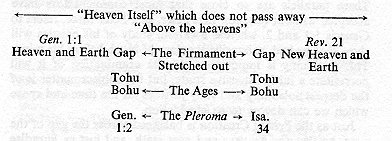
Into the gap caused by the overthrow of Genesis 1:2, is placed the present creation which together with its temporary heaven is to pass away. This present creation, headed by Adam, constitutes the first of a series of "fulnesses" that follow a series of "gaps" until we at length arrive at Him, in Whom "All fulness dwells". We read in Genesis 1 :28, "be fruitful and multiply and replenish the earth" where the word "replenish" is the verb male, a word which as a noun is translated "fulness" in such passages as "the earth is the Lord's and the fulness thereof" (Psa. 24:1). The Septuagint uses the verb pleroo to translate male in Genesis 1 :28. We are, therefore, fully Scriptural when we speak of the six days Creation as a part of the "Pleroma" or "Fulness".
(6) THE TESTIMONY OF PETER TO THE DAYS OF NOAH
After the great gap formed by the loss of Paradise, the record divides into two according as the false or the true seed are spoken of, until we come to the next great crisis, the Deluge. Here history seems to repeat itself. The deep (Heb. tehom) of Genesis 1:2, is not referred to again until we read the record of the flood (Gen. 7:11; 8:2). The "dry land" (Heb. yabbashah, Gen. 1:9,10), which appeared on the third day from beneath the waters, finds an echo in the "drying up" of the earth after the flood (Heb. yabesh, Gen. 8:7,14). There are a number of interesting parallel features between Adam and Noah which establish that the relationship is intentional.
For example, both Adam and Noah are commanded to replenish the earth, both have three sons, one of whom becomes involved in a curse and is either "of that wicked one" or the father of Canaan, who in his turn is seen to be of the evil seed. These parallels are so close that most commentators have accepted without question that Peter, in 2 Peter three, refers to Genesis 1: 1 and 2, whereas a careful study of his epistles will show that he had, primarily, the days of Noah before his mind. This testimony is important, and the examination of it will necessitate a fairly intensive study, but the subject matter is of the deepest solemnity and fully justifies all the time and space which we can devote to its elucidation.
Just as the Primal Creation is balanced across the gap of the ages, by the new heavens and new earth, and just as Paradise lost is balanced by Paradise restored, so the structure persists and another pair of corresponding members appears.
| C | The days of Noah The nations just before the call of Abraham |
a The irruption of the sons of God (Gen. 6) |
b Preservation in the Ark Noah uncontaminated (Gen. 6:9) |
||
c Punishment by flood (Gen. 7,8) |
||
d Spirits in prison (1 Pet. 3:19-22, Jude 6) |
||
| C | As it was in the days of Noah.
|
a Antichrist, and the Son of Perdition (2 Thess. 2) |
b Preservation, the lamb's book of life. Uncontaminated (Rev.21) |
||
c Punishment by fire (Rev. 14:9,10) |
||
d Spirits liberated for a season (Rev.9:14). |
Let us now attend to the teaching of Scripture with regard to this great epoch. A very superficial reading of Scripture will convince the student that there are revealed three great creative movements one past, one present and one future.
- "In the beginning" (Gen. 1 :1). Primal Creation.
- "In six days" (Gen. 1 :3-2:3). Present Creation.
- "In the day of God" (2 Pet. 3:12,13). New Heavens and Earth.
The Primal Creation of Gen. 1: 1 is separated by the chaos of Gen. 1:2 from the Present Creation-while the Present Creation is again separated from the New Heavens and Earth by the dissolution of 2 Peter 3: 10, and the following diagram visualizes this great purpose of the ages.
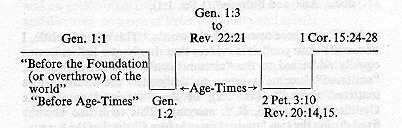
The "first" heaven and earth of Revelation 21:1 is strictly "the former" of two (see Rev. 21:4 where the same Greek word is translated "former"). This is the sequel to the six days' creation, not to Genesis 1:1. A reference to Isaiah 65:17-20, 7 and to 66:22-24 will show that in the new heaven and earth (out. side the Holy Mountain), death will still be possible. Not until the end of the ages, long past the end of the Revelation will the last enemy be destroyed and God be all in all (1 Cor. 15:24-28).
Peter as a minister of the Circumcision, is particularly concerned with that portion of the purpose of the ages that impinges upon the hope of Israel. There is, however, in the history of Israel much that is typical of vaster things, and we are not surprised, therefore, to discover much that adumbrates the larger issues dealt with by Paul alone. This vast sweep of the ages which we have suggested in the diagram given above, finds an echo in the words of Peter, when he speaks of past, present and future heavens and earth, as they appear in the prophetic view of Israel and its hope.
We may use Peter's language as a guide to the wider purpose of the ages thus:
- For Genesis 1:1 we may use the words, "the world that then was".
- For Genesis 1:3-Revelation 20:13 we may use the words, "the heavens and the earth which are now".
- For Revelation 21:1 the words, "the new heavens and the new earth".
Peter was "a minister of the circumcision" (Gal. 2:7-9), and wrote his epistles to
". . . the strangers scattered throughout Pontus, Galatia, Cappadocia, Asia, and Bithynia" (1 Pet. 1:1).
As 2 Peter three opens with the words, "This second epistle, I now write unto you", it is evident that the chapter before us was equally addressed to the "circumcision". The term diaspora, "scattered" became a name to designate "the twelve tribes scattered abroad" (Jas. 1:1), or the "dispersed among the Gentiles" (John 7:35, R.V. margin). This term had become fixed during the two hundred years before Christ that the Septuagint had been in use, for in such passages as Deuteronomy 30:4, Nehemiah 1 :9, Psalms 147:2; diaspora is used of the "outcasts of Israel". As we shall have occasion to compare some of the language of Peter with the Gospel according to Mark, it will be well to make sure that the reader is aware of the close association of these two servants of the Lord.
From Acts 12:12 we learn that Peter was friendly with Mark's mother and in 1 Pet. 5:13 he speaks of "Marcus my son." Jerome speaks of both Paul and Peter with their assistants thus:
"Therefore he (Paul) had Titus for a Secretary, as the blessed Peter had Mark, whose Gospel was composed by him after the dictation of Peter".
To this may be added the testimony of Eusebius:
"After the departure of Peter and Paul, Mark the disciple and secretary (hermeneutes or "interpreter") of Peter, transmitted to us in writing what Peter had preached".
The four Gospels, therefore, stand related to one another as follows:
A Matthew Independent
B Mark Interpreter of Peter
B Luke Fellow worker with Paul
A John Independent.
We are now free to examine 2 Peter three, and we shall remember as we do it, that Peter, the minister of the circumcision, admits in that same chapter that the Apostle Paul has many things to say, which were hard to be understood both by himself and his hearers, and we shal1 not expect to find the sweep backward beyond Gen. 1:2 in Peter's most far-flung statement, that we find in Paul's great epistles of the Mystery. We must now make a preliminary inquiry into the testimony of 2 Peter 3:1-14 and discover the scope of Peter's Ministry and epistle.
We note that chapters one and two must be considered as introductory, for it is chapter three that opens with the words, "this second epistle, beloved, I now write to you", and the burden of the chapter is the denial by "scoffers" of the possibility of the Lord's return by an appeal to a supposed "Uniformity of Natural Law", and the exposure of the weakness of this objection by the Apostle. An examination of the first chapter will show that this was prominently in the Apostle's mind all the time. 2 Peter 1: 16-21 is an anticipation of 2 Peter 3:2,3 and 2 Peter 2:1-22 is an anticipation of2 Peter 3:3-13 and correspond in the structure which will be given later.
These selfsame scoffers, or their predecessors, had evidently charged the believer who expected the personal return of the Lord, with following "cunningly devised fables" (2 Peter 1:16), and from this the Apostle proceeds to the nature and trustworthiness of prophecy, recalling in passing the conviction he himself had received of its truth when upon the Mount of Transfiguration.
The structure of the passage is as follows:
A 2 Pet. I: 16 What the apostle's witness was NOT "Cunningly devised fables"
B 2 Pet. I: 16, 17 What it WAS" Honour and glory"
C 2 Pet. 1:17, 18 How it CAME "The voice from heaven"
B 2 Pet. I: 19 What the Prophetic Word IS "A light, till the day dawn"
A 2 Pet. 1:20 What it is NOT "Not of its own unfolding"
C 2 Pet. 1:21 How it CAME "Moved by the Holy Ghost".
In this opening argument we have similar features that are restated or amplified in chapter three.
Chapter One |
| The Second Coming of Christ. The charge made "cunningly devised fables". The testimony of Apostle and Prophet. The introductory phrase "knowing this first". |
Chapter Three |
| The Second Coming of Christ. The scoffers' charge "where is the promise of His coming?" The testimony of the Prophets and Apostles. The introductory phrase "knowing this first". |
To piece together the complete structure in all its details would take us too long, and is not necessary for our present purpose. The following abridged outline will be all that is required to demonstrate the scope of the epistle and particularly the correspondence that exists between 2 Peter 1 :16-21 and 2 Peter 3:2,3, and 2 Peter 2:1-22 with 2 Peter 3:3-13. If this be realized, we shall have reached the first step in our inquiry.
We draw special attention to the two words "overthrow" katastrophe and "overflow" katakluzo, and the correspondence established between the destruction of Sodom and Gomorrah, with the dissolution of the elements.
THE SECOND EPISTLE OF PETER
A 1 :1-4 Opening Benediction.
Grace, peace, through the knowledge of God.
Called to His own glory
B 1:5-11 Give all diligence-never fall (ptaio)
Give diligence-make sureC a 1:12-15 "Stir up", "remembrance"
b 1:16-21 The Apostles and Prophets
(details given above)
"Knowing this first"
c 2:1-22 False prophets and False teachers
Reference to fall of angels,the Flood
and the destruction of Sodom and Gomorrha
An overthrow (katastrophe)
Lusts of flesh and uncleannessC a 3:1 This second epistle beloved.
I now write unto you: in both which I stir up
your pure minds by way of remembrance
b 3:2, 3 The Prophets and the Apostles
"Knowing this first"
c 3:3-13 Scoffers
Reference to Creation and Flood
Dissolution of elements
Overflow (katakluzo)
Walking after their own lustsB 3:14-17 Be diligent-fall (ekpipto) stedfastness
A 3:18 Closing Benediction.
Grow in grace and knowledge of our Lord and Saviour
To Him be glory.
In the second chapter, which corresponds with the section dealing with the scoffers and their condemnation, Peter speaks of the following recorded interventions of the Lord, showing how untrue the scoffers were when they attempted to rule out the future Divine intervention of the Lord's return by saying, "since the fathers fell asleep all things continue as they were". Pour instances are given by the apostle of judgments that could not be the mere working of natural law.
- The casting down of the angels that sinned (2 Pet. 2:4).
- The bringing in a flood in the days of Noah (2:5).
- The turning of the cities of Sodom and Gomorrha into ashes, condemning them by an "overthrow" katastrophe (2:6.)
- The rebuking of Balaam by the speaking of a dumb ass (2:15,16).
From these examples the Apostle draws the conclusion:
"The Lord knoweth how to deliver the godly out of temptations, and to reserve the unjust unto the day of judgment to be punished" (2 Pet. 2:9).
We have now advanced a step in our pursuit of the truth. The fact has been established, that there were three Creative Movements recorded in Scripture, and that Peter whose reference to Creation is occupying our attention, was a minister of the circumcision, when he wrote his second epistle. To this we have now added some idea of the general scope of this epistle, and of 2 Peter 3:3-14 in particular. We are, therefore, now ready to give 2 Peter 3:3-14 a fuller and more detailed examination.
Before we can come to any definite conclusion about the intention of the Apostle in 2 Peter 3:3-14, we must arrive at some certain understanding of the terms he uses. There are few students of Scripture who, when they read the words of 2 Peter 3 :4, "the BEGINNING of creation", but will go back in mind immediately to Genesis 1:1 and John 1: 1, where the same word arche "beginning" is found either in the Septuagint or in the original Greek N.T. Yet upon examination, such a reference back is proved to be untrue. We have already spoken of Mark the "interpreter" of Peter and the present is an opportunity to test his words. Mark uses the word arche "beginning" four times thus:
A "The beginning of the gospel of Jesus Christ the Son of God" (1:1)
B "From the beginning of the creation" (Mark 10:6)
A "The beginning of sorrows" (Mark 13:8)
B "The beginning of the creation which God created" (13:19)
The two references to creation challenge our attention, and we are sure that the established meaning of these two passages in Mark's Gospel must influence most profoundly our interpretation of the same words in 2 Peter three. Here, therefore, is the second passage in full.
"But from the beginning of the creation God made them male and female" (Mark 10:6).
It is not a matter of debate, therefore, that Mark uses the expression, "the beginning of the creation", to refer exclusively to the creation of Genesis 1:3-2:3, and so by logical necessity cannot include Genesis 1:1. Let us read the second reference:
"For in those days shall be affliction, such as was not from the beginning of the creation which God created unto this time, neither shall be" (Mark 13:19).
All we need to do to show that the same limitation must be observed is to place beside this reference, two parallel passages.
"For then shall be great tribulation, such as was not since the beginning of the world to this time, no, nor ever shall be" (Matt. 24:21).
"There shall be a time of trouble, such as never was since there was a nation, even to that same time" (Dan. 12:1).
We cannot conceive that any reader with these passages before him, would wish to read into Mark 13:19 a reference back to Genesis 1: 1. The words "since there was a nation" being the earliest statement, out of which the others have grown.
We are, therefore, certain that the words quoted by Peter "from the beginning of the creation" are limited to the Adamic earth. The context moreover of any expression has a part to play in deciding its meaning, so we must now ob serve the way in which it is introduced and with what other terms it is associated.
"Since the fathers fell asleep, all things continue as they were from the beginning of the creation".
It is strange enough to think of linking up the death of Abraham, Isaac and Jacob ("the fathers") with the six days' creation; it is unthinkable when we attempt to link such events with the remote period of Gen. 1: 1. The argument appears to be that just as the "fathers" died one after the other, and no interference with "nature" has yet broken the hold of death, so, from the beginning of the world all things have continued without a break, and ever will, so rendering either the hope of resurrection, the Second Coming or the Day of Judgment unreasonable.
Peter, however, has already met this argument. Did all things continue as they were, in the days of Noah? Was there no Divine intervention in the days of Sodom? Is there no import in the use of the two distinctive words katastrophe and katakluzo?
Further, we must not forget that the words in question were spoken by the "scoffers". What did these scoffers know bout the primal creation? What did they know of the "overthrow of the world"? Not one of them so far as there is any record had ever seen the skeleton of a brontosaurus or a fossilized ichthyosaurus. The science of their day made creation originate from chaos (see Hislop's Two Babylons), and these scoffers most certainly did not know more of ancient history than the inspired Apostle.
In his opening rejoinder the Apostle says, "For this they willingly are ignorant of", a sentence that does not do justice to either the English language or the inspired original. The R.V. reads, "for this they wilfully forget" and Dr. Weymouth renders the passage, "for they are wilfully blind to the fact". No person can be charged with "wilful forgetfulness" if the matter lies beyond his ken. The heathen world was without excuse in their idolatry because of the witness of creation around them, but not even the scoffers could "wilfully neglect" the evidences of the primal creation because they were unrevealed and were unattainable by human search at that time. These scoffers, however, could be charged with wilful neg1ect of the Divine record of Genesis which shows how the selfsame water that played so prominent a part in the six days' creation, was actually used to bring about the flood in the days of Noah. This they could have known, and with its neglect they could be charged.
Lanthano, the word translated "be ignorant" in 2 Peter 3:5 A.V. occurs again in verse 8, "be not ignorant of this one thing". This fact must not be "ignored" by ourselves, as it is evident that such a recurrence indicates a structural feature, and is of consequence to true interpretation. The word lanthano seems to demand an English equivalent that lies somewhere between the "ignorance" of the A.V. and the "forgetting" of the R.V., and Moffatt seems to have chosen wisely here, for he renders the word in both passages "ignore". Ignorance of any fact modifies the culpability of a person, forgetfulness while serious, nevertheless modifies the guilt of an act, but to "wilfully ignore" leaves no such margin of excuse, and that is the thought here. Without making too great a diversion by dealing with the structure of 2 Peter 3: 1-13 as a whole, it will be sufficient for our present purpose to confine ourselves to verses 4-9.
A |
1 Pet. 3:4 |
The Promise. |
Where is this promised Advent? False argument derived from misconception as to time |
||
B 2 Pet. 3:5-7 |
They wilfully ignore |
a Heavens of old and Earth |
Water |
||
b The Word |
|||||
c The World |
|||||
d Perished |
|||||
a Present Heaven and Earth |
Fire |
||||
b Same Word |
|||||
c Ungodly Men |
|||||
d Destruction |
|||||
B 2 Pet. 3:8 |
Do you not ignore |
The argument concerning relative time |
|||
A |
2 Pet. 3:9 |
The Promise |
The apparent "slowness" of the Lord must not be misconstrued as "slackness". The day of the Lord will come. |
||
God does not hold man accountable where knowledge is unattainable. Knowledge concerning things that happened during the Primal Creation of Genesis 1:1 could not be "ignored" by anyone, because no details are given in the Revealed Word. These men, however, could, and evidently did, wilfully ignore the testimony of Genesis 1:3-8:22, and so were without excuse. The reference to "the world that then was being overflowed with water perished" must either refer to the chaos of Genesis 1:2 and must exclude the flood in the days of Noah, or it must refer to the flood of the days of Noah and exclude Genesis 1:2, it cannot refer primarily to both. We have positive evidence that Peter makes reference to the Deluge of Noah's day as part of his teaching and while this does not prove anything so far as 2 Peter 3:6 is concerned, it is a weight in the scale. We must continue our study of the terms used by Peter.
"The heavens were of old". Do these words refer to the primal creation of Genesis 1:1? or do they refer to the creation of the world for Adam and his race? Ekpalai occurs in but one other passage in the N.T., namely in 2 Peter 2:3.
"Whose judgment now of a long time lingereth not".
There is no need for any argument here. These false prophets must belong to the Adamic creation, and consequently there is added reason to believe that Peter's second use of the term will be but an expansion of the first, and that 2 Peter 3:6 refers back as far as Genesis 1:3 but no farther.
Palai simply means "old", palaios, palaiotes and palaioo also occur and should be examined. We give just two examples.
"But he that lacketh these things is blind, and cannot see afar off, and hath forgotten that he was purged from his old sins (2 Pet. 1:9).
"God Who at sundry times and in divers manners, spake in time past" (Heb. 1:1).
The expression, "the heavens were of old", therefore refers quite legitimately to Genesis 1:6. This "firmament" was temporary and is to pass away, as many passages of Scripture testify. There is no passage, however, that teaches that Heaven Itself, the dwelling place of the Most High, will ever pass away, and this is an added reason for limiting Peter's words to the present creation.
The earth "standing" out of the water, appears to refer to the way in which the present system was brought into being. Sunistemi is translated "consist" in Colossians 1:17, and while it would take a scientist to explain the meaning of 2 Peter 3:5, the reference is so evidently back to Genesis 1:3 onwards that scientific pro of is not necessary to our argument.
The association of the "water" and creation, with the "water" that caused the "overflow" of 2 Peter 3:6, is emphasized when one observes that after the many references to water in Genesis one, no further mention is made until the ominous words of Genesis 6: 17 are reached, "I do bring a flood of waters upon the earth".
These things the scoffers "wilfully ignored". The future dissolution will involve the heavens as well as the earth (2 Peter 3:10) whereas it was "the world" not the heaven and the earth that "perished" in the days of Noah. The heavens and the earth remained, and so could be called by Peter "the heavens and the earth which are now". In the second chapter of his epistle, Peter refers to the Flood and speaks of "the old world" and "the world of the ungodly" (2 Peter 2:5), similarly in both 2 Peter 2:4 and 2 Peter 3:7 he uses the word "reserved" in reference to judgment.
Again in 2 Peter 3:6 the Greek word katakluzomai is used where the translation reads "being overflowed with water". In 2 Peter 2:5 he uses the word kataklusmos (which becomes in English "cataclysm") "bringing in the flood upon the world of the ungodly", which makes the parallel between these two chapters even more obvious. The result of our examination leaves us with the conviction that Peter refers to the creation that came into being for the habitation of man, and that we are not justified in using his words to cover the whole of the record of Scripture, except as a type and shadow of the greater event.
(7). PARADISE LOST AND RESTORED
If "before the overthrow of the world" and "before the age times" refer to the same datum line, and, if the "overthrow" be Genesis 1:2, then this must have taken place before the ages began, and consequently we have an indication that the ages are coincident with the present temporary creation, which together with its "firmament" will pass away when the purpose of the ages shall be accomplished.
The opening and dosing members of the Purpose of the Ages may be set out as follows:
| A | The beginning "Before Age times" |
a Christ Firstborn of all Creation. Image of Invisible God times |
| b Satan Cherub (Ezek. 28:12-19) | ||
| c The overthrow (Gen. 1:2) | ||
* * * * * * * * * * * * *
|
||
| A | The End Ages Finish |
a Christ Head Every knee shall bow |
| b Church In the heavenlies. Satan destroyed |
||
| c Reconciliation achieved. | ||
The space indicated by the * * * is spanned by the ages. The first of the series of fulnesses that fill this gap is, as we have seen, the "six-day creation" of Genesis 1:3-2:3.
The opening "generation" is NOT that of Adam, as recorded in Genesis 5:1, but of "the heavens and the earth" which occupies Genesis 2:4-4:26. This is followed by twelve generations, which open with "the book of the generations of Adam" (Gen. 5:1), and doses with "the book of the generation of Jesus Christ".
The relationship of these generations may be set out as follows:
A The generations of the heavens and the earth (Gen. 2:4-4:26)
A a The BOOK of the generations of Adam (Gen. 5:1, 6:8) Plural
b The generations of Noah (Gen. 6:9-9:29)
c The generations of the Sons of Noah (Gen. 10:1-11 :9)
d "The generations of Shem (Gen. 11: 10-26) The Seed
e The generations of Terah (Gen. 11 :27-25:11) Mesopotamia
f The generations of Ishmael (Gen. 25:12-18) Bondwoman
f The generations of Isaac (Gen. 25: 19-35 :29) Free woman
e The generations of Esau (Gen. 36: 1-43) Canaan
d The generations of Jacob (Gen. 37:2-50:26) The Seed
c The generations of Aaron and Moses (Num. 3:1-4)
b The generations of Pharez (Ruth 4: 18-22) The Seed
a The BOOK of the generation of Jesus Christ (Matt. 1 :1-17) Singular.
It will be observed that the word "generation" is used in the plural of each except the last. The generations refer to the descendants, as may be seen by an isolated generation like that of Ruth 4:18-22, the generation of Jesus Christ however, refers to His human ancestry not to His descendants, for He had none. In the generations of the heaven and the earth, are recorded the following features:
- The forming of man from the dust, and his becoming a living soul.
- The planting of the garden eastward in Eden.
- The prohibition concerning the tree of the knowledge of good and evil.
- The naming of the animals and Adam's conscious loneliness.
- The formation of the woman as a help meet for him.
- The temptation and the fall, the curse and sorrow.
- The promise of the seed of the woman and ultimate victory.
- The return of man to the dust from whence he had been taken.
- The expulsion from Eden and the placing of the Sword and Cherubim.
- The two seeds as manifested in Abel and Cain.
- The appointment of Seth "instead" of Abel.
Fuller details could, of course, be included, and the reader must remember that there is no significance in the number that we have indicated. In view of the balancing feature in the book of the Revelation we can write over this period the words "Paradise Lost", without borrowing any ideas from Milton, even as we can write over the closing chapter of the Revelation "Paradise Restored".
Two main themes commence in Genesis three, that continue to the end of time, and which constitute the conflict of the ages. These are (1) the promise of the woman's seed, (2) the continuous enmity between the two seeds until ultimate victory is achieved. (See booklet on "Job".) The loss sustained as a consequence of the fall is symbolized in the expulsion from the garden, with the consequent loss of access to the tree of life, but restoration is pledged by the placing of the Cherubim together with a flaming sword "to keep" the way of the tree of life. (See CHERUBIM.) In the sequel, when the intervening gap is fi1led by the fruits of redemption, we are taken by a series of steps back to Eden and its blessedness, as is made manifest by the following extract from the close of Revelation.
"And God shall wipe away all tears from their eyes; and there shall be no more death, neither sorrow, nor crying, neither shall there be any more pain: for the former things are passed away . . . and he shewed me a pure river of water of life, dear as crystal, proceeding out of the throne of God and of the Lamb. In the midst of the street of it, and on either side of the river, was there the tree of life . . . and there shall be no more curse . . . that they may have right to the tree of life, and may enter in through the gates into the city" (Rev. 21:4; 22:1-3,14).
Here is the complete reversal of the consequence of the fall of man in Eden, and we have surveyed yet another "fulness", the fulness of Redemption that spans the ages and their burden of sin and death. The creation of the universe, being the act of the infinitely wise God, brought into being a definite purpose, and that purpose can be perceived at least in some measure by reading what the Scriptures indicate will be the condition of things at the end. The Tabernacle of God will then be with men and He will dwell with them, God will be all in all. Two things are linked with the Cherubim in the Scriptures, "dwelling" (1 Sam. 4:4), and "speaking" (Num. 7:89).
Where the word is used in the singular, we read, "He rode upon a Cherub and did fly", but this has to do with deliverance from enemies. While we read both in Exodus and Ezekiel of a "Cherub" in the singular, it always has reference to "one" of the Cherubim, but in Ezekiel 28: 14 and 16 "the anointed Cherub" seems to be associated with "the overthrow of the world". The change from the singular to the plural takes place after the fall of man, and the Cherubim with their four faces, the lion, the ox, the man and the eagle, symbolize Adam and the dominion put in subjection under his feet, who in turn is the figure of Him that was to come. While the purpose of God to dwell with His creatures was temporarily checked by the failure of the first creation, it was reintroduced at the creation of man, for we have the homely words of Genesis three, that speaks of the "voice of God" in the garden at the cool of the day" and the call, "Adam, where art thou?" Once again the fall of the creature hindered the attainment of the Divine purpose, yet Love found a way; the purpose was not abandoned but the whole purpose was placed upon a redemptive basis, consequently the Cherubim are seen to be an integral part of the Mercy Seat. Some idea of the way the purpose is pursued through the ages may be visualized by the following graph:
ORIGINAL PURPOSE Purpose to dwell. The Cherub. "Cover" (Ez. 28: 14, 16, Ex. 26:14). |
THE "GAP" FILLED Cherubim. Man and his dominion, sin enters and Cherubim now part of the Mercy seat |
THE GOAL REACHED "The Tabernacle of God is with men and He will dwell with them". |
|
THE OVERTHROW OF THE WORLD |
DISSOLUTION OF HEAVEN |
||
From the "Anointed" that failed, on via the cross to the glory of the "Anointed" Who gloriously succeeded, the purpose of love is carried to its goal on the wings of the Cherubim, or rather on the grace that these strange creatures set forth. Thus the outstretched firmament coincides with the outstretched wing of t4e Cherubim, the whole span of the ages being Under the Redeeming AEgis.
"The term aegis', really a Latin word, means 'a goat skin', and later a shield. . . . This redeeming conception took on a primeval form in the cherubim set up, together with the sword of flame, at the gate of the lost Eden. . . the idea of atonement, therefore is as old as the Bible, nay as redemption itse1f. . . . This 'day of Atonement' itse1fwas called 'Yom Kippur', i.e. the 'Day of Covering'. . . . Ours is at bottom an evangelica1 universe, no other form was ever conceived for it in the mind of God". (Under the Redeeming AEgis, by H. C. Mabie, D.D., LL.D.).
We can, therefore, set out the steps of the goal of the ages, thus:
B |
The Ages begin Paradise lost |
Earth |
Remade and blessed (Gen. 1:2-2:4) Subjected to curse. Thorns and thistles (Gen. 3) |
Man |
For a little lower than angels (Psa. 8) The First Adam. living Soul. The image of God Dominion over the earth |
||
Usurper |
The Serpent. The Shining one Nachash (Gen. 3) Ye shall not surely die Ye shall be as God |
||
Hope |
The seed of the woman |
||
* * * * * * * * * * * *
|
|||
8 |
The Consummation of the ages Paradise Restored |
Earth |
Restored and blessed (Hos. 2: 18-23) Curse removed (Rev. 22:3, Isa. 55:13) |
Man |
Christ, made much better than angels (Heb. 1:4) last Adam. Quickening Spirit. Image |
||
Heir |
Lamb is the light, brightness of glory Immortality conferred (1 Cor. 15) Every knee shall bow |
||
Hope |
Creation's groan hushed (Rom. 8:21, 16:20). |
||
(8) THE FILLING UP OF THE NATIONS (Gen. 48:19, Rotherham)
The family of Noah after the flood were told to "replenish" the earth, which would have consisted a fulness, had this replenishing been accompanied by grace and righteousness. Alas, by the time we reach the eleventh chapter of Genesis, the evil character of the world was made manifest, and Babel, and the scattering of the people, brought another movement in the purpose of the ages to a close. Babel in Genesis eleven, will yet find its corresponding member when great Babylon comes up for judgment, but the gap formed by the rebellion of Nimrod and the introduction of idolatry which is so closely associated with this mighty hunter before the Lord, was filled by the calling of Abraham and the promises made to him concerning the great nation Israel.
In Genesis 48:19 we read, "his seed shall become a multitude of nations". It so happens that the word "multitude" occurs earlier in this same chapter, namely in verse 4, where we read:
"Behold I will make thee fruitful and multiply thee, and I will make of thee a multitude of people" (Gen. 48:4).
Two words are found in the Hebrew original which are here translated "multitude" and these must be distinguished.
The word translated "multitude" in verse 4 is the Hebrew word qahal "to call" or "to assemble" , but the word translated "multitude" in verse 19 is entirely different, it is the Hebrew word melo "fulness". Readers who use The Companion Bible (early editions) should observe that the note against "multitude" in verse 19 should be transferred to the margin of verse 4 in the same chapter.
Let us bring together three more passages which make the promise that Israel shall be a multitude or company of people or nations.
"And GOD ALMIGHTY bless thee, and make thee fruitful, and multiply thee, that thou mayest be a multitude of people" (Gen. 28:3).
"And God said unto him, I am GOD ALMIGHTY; be fruitful and multiply; a nation and a company of nations shall be of thee" (Gen. 35:11).
"Behold I will make thee fruitful and multiply thee, and I will make of thee a multitude of people" (Gen. 48:4).
In these passages "multitude" translates the Hebrew word qahal. When Jacob blessed Joseph's younger son Ephraim, putting his right hand upon his head, instead of upon the head of Manasseh his elder brother, Joseph said:
"Not so, my father," Jacob answered, "I know it, my son, I know it: he also shall become a people, and he also shall be great: but truly his younger brother shall be greater than he, and his seed shall become a multitude of nations" (Gen. 48:19).
Here, as we have already observed, the Hebrew word translated "multitude" is melo, "fulness".
We must, therefore, become acquainted with the usage and meaning of these two words which are translated "multitude" before we can proceed with our study. Qahal, means "to call together", "to assemble", and the noun form is translated "congregation", "assembly" and "company". In seventy passages, the Septuagint renders the Hebrew qahal by ekklesia, and Stephen speaks of "the church in the wilderness" (Acts 7:38). In the three passages quoted from Genesis, "multitude" and "company" are represented by "synagogue" in the Septuagint. In Genesis 48:19 melo which is translated "multitude" is rendered in the Septuagint plethos, which in the N. T. is rendered by the A.V. "multitude" thirty times, "company" once and "bundle" once. Unfortunately the English word "multitude" has to stand for two very different conceptions. Plethos, is from the same root as pleroma and retains the idea of fulness or filling, but there is another Greek word translated multitude, namely ochlos which means rather "a crowd" or "a mob", the unruly nature of which is reflected in the verbal forms which mean "to vex" or "to trouble" (Acts 5:16; 15:19; 17:5, Heb. 12:15). While, therefore, we are compelled to use the English word multitude in these passages of Genesis, we must dismiss the thought of a "mob" or of an unruly "crowd", and retain the idea of a properly assembled gathering and a filling.
Returning to the usage of the word qahal, we ob serve that from Exodus 12:6 where we read "the whole assembly", the word is used of Israel as a nation, but in Genesis, before Israel as a nation existed, it is used prophetically, looking down the ages to the day when the seed of Abraham shall indeed become "a filling of the nations" (Rotherham). The four occurrences of qahal fall into their place in the structure, which can be seen set out in full in The Companion Bible.
The following extract will be sufficient to demonstrate this fitness here.
Gen. 27:42-28:5. Departure. Jacob to Padan-aram
"that thou mayest be a multitude of people"
* * * * * * * *
Gen. 35:1-15. Return. Jacob from Padan-aram
"a nation and a company of nations"
Gen. 48:1-20. Blessing of Joseph and his sons
"I will make of thee a multitude of people"
* * * * * * * *
Gen. 49:1-28. Blessing of all his sons
"unto their assembly, mine honour, be not thou united",
It will be remembered that in the endeavour to obtain the birthright and the Abrahamic blessing, Jacob, at the instigation of his mother who knew that "the elder shall serve the younger" (Gen. 25:23), attempted by fraud to make the prophecy sure, but failed. When Jacob as a consequence was obliged to leave home, the coveted blessing for which both he and his mother had schemed was given to him freely:
"And GOD ALMIGHTY bless thee, and make thee fruitful, and multiply thee, that thou mayest be a multitude of people; and give thee the blessing of Abraham, to thee, and to thy seed with thee; that thou mayest inherit the land wherein thou art a stranger, which God gave unto Abraham" (Gen. 28:3,4).
Not only is "the land" a definite feature of this promise, but a peculiar character attaches to it, it is called "the land wherein thou art a stranger". This is repeated in Genesis 37:1 and in 47:9 Jacob uses the same word where it is translated "pilgrimage", The margin of Genesis 28 :4, reads, "the land of thy sojournings". This term is used seven times in the law and is repeated in Hebrews 11:9,13. After the formation ofIsrae1 and the giving of the law, the nation is not again reminded that they were strangers and sojourners except in one passage, namely in Leviticus 25:23, where the laws governing the sale of land showed that the Lord Himself was the true Owner, Israel only holding the land as it were on a lease. One further note is necessary before we attempt a conc1usion, and that concerns the word translated "nation". An attempt has been made, in order that a certain popular theory might be supported, to show that Ephraim was to become "Gentilized". The Hebrew word translated "nations" is goyim, the plural of goi. This word is translated in the A.V. as follows: "Gentile" thirty times, "heathen" 142 times, "nation" 373 times, "people" eleven times. It is easy, when we are reading the passages where "Gentile" and "heathen" occur, to jump to the conc1usion that the word means, "all nations of the world, excepting the Jews", but this is an error.
The first six occurrences of goyim occur in Genesis ten, and as Israel was not in existence at the time, it is evident that the word can only mean "nations"; the inclusion of the word "Gentiles" in the A.V. of Genesis 10:5, being an anticipation and having no immediate meaning until placed over against the word "Jew". The R.V. has recognized this, and inserted "nations" instead. In Genesis 12:2 we read the words of the great prophetic promise to Abraham concerning his seed, Israel, "I will make of thee a great nation", while in Genesis 17:4,5,6 this promise is expanded to include "many nations", returning in 18:18 once more to the "great nation". So in Genesis 35:11 we read, "a nation and a company of nations", the only distinction between Jew and Gentile being, not in the use of a different word, but in the use of the singular for the Jew, and the plural for the Gentile. So again in Deuteronomy four, we have interchangeably "this great nation" , "what nation is so great", "the heathen" , "a nation from the midst of another nation" and "the nations" , that were to be driven out of Canaan, all being translations of the one Hebrew word. Even in the Greek N.T. when the distinction between Jew and Gentile is acute, we still find ethnos used both of the Gentiles and of Israel (Acts 22:21; 26:4,17; 28:19,28). (See GENTILE.)
While, therefore, goyim means at times Gentile or heathen, it always means "nation" whether the nations outside the covenant, or the great nation of promise. The promise that Israel should be "great" must not be misunderstood. With us, "greatness" is associated with nobility of mind, but originally the word gadol translated "great" means "growth" or "augmentation", So we read of "great lights", "great whales", a "great city" in Genesis. The word, moreover, is used to indicate "the elder" son (Gen. 10:21; 27:1; 29:16) who may not necessarily have been "greater".
Israel today are indeed at the present day "minished and brought low through oppression" (Psa. 107:39), but it is an integral part of the promise to Abraham, that Israel should not only be great in spiritual qualities, but great in numbers. The promise reads, "I will make thy seed as the dust of the earth: so that if a man can number the dust of the earth, then shall thy seed also be numbered" (Gen. 13:16).
The figure is changed in Genesis 15:5 to the innumerable stars of heaven, with the added words, "so shall thy seed be". Yet once again the figure is changed to "the sand upon the sea shore" (Gen. 22:17).
"Sir Arthur Eddington is of the opinion that one hundred thousand million stars make one galaxy, and one hundred thousand million galaxies, make one universe. The number of stars in a universe therefore would be ten thousand trillion, or expressed in figures,
10,000,000,000,000,000,000,000,
that is equal to the number of drops of water in all the oceans of the world, or grains of fine sand sufficient to cover the whole of England and Wales, to a depth of a foot, and each one of them comparable in size to our sun". (The Endless Quest, Westaway.)
While it is not intended that Israel are ever to reach such astronomical figures, the contemplation of the possible number of the stars, compels us to admit that an extraordinary increase in number constitutes an essential feature of the Divine purpose for this "great nation". According to Deuteronomy 1:10 these promises were on the way to fulfilment even when Israel stood upon the borders of the promised land, and the present drop in their numbers is coincident with their being in disfavour. "If ye walk contrary to Me, I will make you few in number" (Lev. 26:21,22).
When at length the Lord causes the captivity of both Judah and of Israel to return "as at the first", when He performs that good thing which He has promised unto the house of Israel and of Judah, then "as the host of heaven cannot be numbered, neither the sand of the sea measured: so will I multiply the seed of David My servant, and the Levites that minister unto Me saith the Lord" (Jer. 33:7,14,22).
At the time of the end of this age the world will be so ravaged and desolated by the destructive method of atomic or other superscientific weapons that the prophet Zechariah speaks of "every one that is left of all the nations which came against Jerusalem" (Zech. 14:16), words that suggest a terrible depletion in the number of the inhabitants of the earth at that day. In Zechariah 13:8 the prophet's meaning is made very c1ear, when he says, "and it shall come to pass, that in all the land, saith the Lord, two parts therein shall be cut off and die; but the third shall be left therein". Something of what may be expected when atomic warfare breaks out over this devoted earth can be sensed by the words of the Apocalypse:
- "The third part of trees was burnt up".
- "The third part of the sea became blood".
- "The third part of the ships were destroyed".
- "The third part of men, slain (Rev. 8:7,8,9; 9:15).
The day is passed when these catastrophic times could be brushed aside as mere figures of speech, we have lived through days when "a third part of the ships" were well nigh literally destroyed. We have seen that following the desolation of Genesis 1:2 came the creation of man and the command, "replenish the earth". We have seen that the same command was given to Noah after the catac1ysm of the flood. This same command will be fulfilled in Israel when they, too, shall "blossom and bud, and fill the face of the world with fruit" (Isa. 27 :6). Ephraim, as the "firstborn" will indeed be great, and his seed "shall become a FILLING UP of the nations" (Gen. 48:19).
Once again we see the principle of the pleroma at work, with its promise of a better day, when sorrow and sighing shall have fled away, when the true seed shall flourish, and the seed of the serpent be no more.
(9) THE FULNESS OF THE GENTILES (Rom. 11 :25)
We have seen that the promise to Abraham concerning his seed, has followed the same pattern that has characterized the earlier moves in the outworking of the purpose. Their failure came to a head just before the Babylonian captivity and, with Nebuchadnezzar, "the times of the Gentiles" began.
"In the third year of the reign of Jehoiakim king of Judah came Nebuchadnezzar king of Babylon unto Jerusalem, and beseiged it. And the Lord gave Jehoiakim king of Judah into his hand, with part of the vessels of the house of God: which he carried into the land of Shinar to the house of his god" Dan. 1:1,2).
With these words the book of Daniel opens, and it may not be too much to say that they are only paralleled by the words of Acts twenty-eight in their burden of crisis and dispensational change. With such vast issues hanging upon these momentous words, vast because they cover the whole sweep of Gentile dominion, and vaster still because they lead steadily on to that kingdom of Christ which is to last for ever, with such issues and such a burden, no pains should be spared in acquainting ourselves with all that God has written for our learning in relation to this crisis in the history of man. Space will not permit of the full quotation of Jeremiah 25:1-26. We can but point out one or two features that connect this passage with the opening words of Daniel.
The reader will be struck by the fact that whereas Dan. 1: 1 speaks of the "third" year of Jehoiakim, Jeremiah 25: 1 speaks of the "fourth" year of that same king in connexion with the coming of Nebuchadnezzar against Jerusalem. This apparent discrepancy has not passed unnoticed by the critic, being one of his many "proofs" of the untrustworthiness of the book of Daniel.
The Hebrew word translated "came" in Dan. 1: 1 is bo, and it frequently has the sense of "went" or "marched". This, however, has been denied. Dr. Samuel Davidson says, "the verb bo does not mean to set out. . . but to arrive at" . . . (Introduction to the O.T., Vol. ID, p. 181), and, when men of such standing and authority speak thus, who are we to oppose them? Humility is indeed a grace to seek and preserve, but while Galatians two remains for our encouragement, we may still dare to bring all statements to the touchstone of the Word. Dr. Davidson's statement but illustrates the uncritical character of so-called "higher criticism" for it has been computed that the Hebrew word bo is used in the sense of "to set out" in each of the five books of Moses, in Joshua, Judges, Ruth, Samuel, Kings, Chronic1es, Ezra, Nehemiah, Esther, Job, Psalms, Proverbs, Isaiah, Jeremiah, Ezekiel, and in six out of the twelve minor prophets !
Let us look at Jonah 1:3 and translate it as Dr. Davidson would have it: "And Jonah . . . sent down to Joppa, and he found a ship arriving at Tarshish"! If this could be sense, then in some miraculous way Jonah would have no sooner set foot on board at Joppa than he would have "arrived" at Tarshish.
Doubtless this would have made the journey far more pleasant than it actually was, but the simple fact is that the Hebrew word bo does mean that the ship was "going" or "setting out" for Tarshish. The plain fact of Daniel one and Jeremiah twenty-five is that the former writer tells us the year in which Nebuchadnezzar "set out" from Babylon, while the latter tells us when he "arrived". Moreover, Jeremiah tells us what occupied Nebuchadnezzar on his journey from one capital to the other.
"Against Egypt, against the army of Pharaoh-necho king of Egypt, which was by the river Euphrates in Carchemish, which Nebuchadnezzar king of Babylon smote in the fourth year of Jehoiakim the son of Josiah king of Judah" (Jer. 46:2).
Instead therefore of discovering a discrepancy in the narrative of Scripture, we have the obvious fact that Nebuchadnezzar took time to accomplish this march from Babylon to Jerusalem, and was obliged to meet and overcome Pharaoh at Carchemish by the Euphrates before he could arrive.
In Jeremiah 25:3 the prophet reminded Israel that since the thirteenth year of Josiah (see Jeremiah 1:1,2), the word of the Lord had come urging them to turn from their evil, and because they had not turned He said:
"Behold, I will send and take all the families of the north, saith the Lord, and Nebuchadnezzar the king of Babylon, my servant, and will bring them against this land. . . and this whole land shall be a desolation, and an astonishment; and these nations shall serve the king of Babylon seventy years" (Jer. 25:9-11).
What God therefore had threatened, He brought to pass in the fourth year of Jehoiakim, and the historic record of the captivity of Jehoiakim is found in 2 Chronicles thirty-six, the last chapter of the Hebrew Bible!
Yet with all this apparent on the surf ace of Scripture, and needing no more scholarship than ability to read in one's mother tongue, Kuenen in his historic Critique de I' Ancien Testament has the audacity to say:
"We know by the book of Jeremiah that no such event (as the siege of Jerusalem, Dan. 1: I) took place in the reign of Jehoiakim".
"We know"! We also know that it is written, "professing themselves to be wise they became fools", and by such statements they demonstrate that they are but "blind leaders of the blind".
Jehoiakim was appointed king of Judah by Pharaoh-nechoh in the place of Jehoahaz (2 Kings 23:34). He did evil in the sight of the Lord, and filled Jerusalem with innocent blood. He was succeeded by Jehoiachin. In the reign of the latter, Nebuchadnezzar carried out thence all the treasures of the house of the Lord, whereas Daniel 1: 1,2 tells us that at the first he only carried away a part.
Jehoiachin or Jeconiah is deprived of the Jehovah element in his name, and under the name Coniah is utterly rejected by the Lord:
"Thus saith the Lord, Write ye this man childless, a man that shall not prosper in his days: for no man of his seed shall prosper, sitting upon the throne of David, and ruling any more in Judah" (Jer. 22:30).
It is evident that Israel is passing; dominion is leaving them and is being transferred for the time being to the Gentiles. This is emphasized by such statements as Daniel l :2; "And the Lord gave. . . into his hand", or Jeremiah 25:1: "The fourth year of Jehoiakim . . . that was the first year of Nebuchadnezzar". The times of the Gentiles had therefore begun. And so with Zedekiah the glory departs, and Ezekiel twenty-one reveals the condition of things that will obtain "until He come":
"And thou, profane wicked prince of Israel, whose day is come, when iniquity shall have an end, thus saith the Lord God; Remove the diadem, and take off the crown: this shall not be the same: exalt him that is low, and abase him that is high. I will overturn, overturn, overturn it: and it shall be no more, until He come Whose right it is, and I will give it Him" (21:25-27).
"Until He come"; Gentile dominion obtains on the earth until the coming of the Son of Man. No interim "Kingdom" is to be found here. Daniel's prophecies are occupied with this period of overturning, of the exalting of the base and abasing of the high. "This shall not be the same", saith the Lord, "this shall not be this", as the Hebrew reads, i.e. Nebuchadnezzar's dominion and dynasty would not be a real continuance of the throne of David. It wou1d be in character rather a rule and dominion of wild beasts. The words, "it shall be no more, until He come", leave us in no doubt that the throne thus vacated shall be occupied by none other than the Lord Jesus Christ Himself.
The times of the Gentiles are characterized by one great feature, marked by the Lord in Luke 21:24, "and Jerusalem shall be trodden down of the Gentiles, until the times of the Gentiles be fulfilled". The kingdoms that succeeded Babylon may have been larger or smaller, more powerful or weaker, more autocratic or less so, but the one essential characteristic of Babylon, Persia, Greece, Rome, Turkey and any succeeding mandatory power is the Gentile domination of Jerusalem. That is the great distinguishing feature, and will only be removed when "He comes Whose right it is".
We have, therefore, a period of time which fills the "gap" caused by Israel's failure, which gap is filled by the dynasty started with Nebuchadnezzar and which will persist until, in the Day of the Lord, "the stone cut out without hands" strikes this colossus, and "the kingdoms of this world become the kingdom of our Lord and of His Christ".
It is characteristic of the times of the Gentiles that this Jerusalem should be "trodden down". Those times will not end until Jerusalem is free from the yoke of Gentile dominion, surveillance or protection. Each succeeding ruler of the Gentiles has dominated Jerusalem-Babylon, Medo-Persia, Greece, Rome, Turkey, the League of Nations, the British Mandate, the United Nations, and so on to the last great Dictator and his ten subsequent kings at the time of the end.
When Jerusalem is at length free, the times of the Gentiles will be "fulfilled" (pleroo), and "the fulness (pleroma) of the Gentiles" will have come (Luke 21 :24, Rom. 11 :25). Immediately following this statement concerning the times of the Gentiles, the epistle to the Romans goes on to say "and so" or "thus" "all Israel shall be saved" (Rom. 11:26). The "gap" in the outworking of the Divine purpose in Israel is stressed in Romans 9-11, because of their failure, but a "remnant" shall be saved at the beginning, for had the Lord not left them a "seed" they would have been like Sodom and Gomorrah.
Throughout the period covered by the Acts, "all day long" the Lord stretched out his hands "to a disobedient and gainsaying people" (Rom. 10:21). However low Israel may have fallen during this period, the answer of God to Elijah has a parallel, "I have reserved to Myself seven thousand men, who have not bowed the knee to the image of Baal" (Rom. 11:4). Yet such is the grace of God, the very diminishing of them" led to the enriching of the Gentiles, and leads the Apostle to ask, "how much more their fulness?"
The figure of the olive tree, with its broken branches but emphasizes the "gap" that is in view, and the fulness of the Gentiles occupies the interval occasioned by Israel's blindness (Rom. 11:25). Israe1's failure, in the days of Nebuchadnezzar led to the times of the Gentiles, speaking nationally, but Israel's spiritual failure registered in Acts twenty-eight led to the present dispensation of Gentile blessing, the Church which is called by the wondrous title, "the fulness of Him that :filleth all in all". This, however, is so great a theme that it must be considered in a separate study.
(10) THE TITLE HEAD, AND ITS RELATION TO "THE FULNESS"
The highest title ascribed to Christ in any dispensation other than that of the Mystery is that of "a Priest for ever after the order of Melchisedec". This priesthood is superior to that of Aaron, it functions at the right hand of God, its sphere is the true tabernacle which God pitched and not man, namely "heaven itself", and it combines the two offices of King and Priest. Just as water cannot rise above its own level, so no calling can rise above the position set by Christ, and the calling that recognizes Him as King-Priest is itself "a Kingdom of Priests", "a holy nation and a royal priesthood".
It is significant that throughout the Prison Epistles, Christ is never called either "King" or "Priest", even as it is equally true that the church of that calling is never called a kingdom or a priesthood, but is called "the Body" of Christ. Argument from the absence of terms, like arguing from a negative is in most cases suspect, but in this particular instance it cannot be said that a "kingdom" is never mentioned in the Prison Epistles. We read in Ephesians 5:5 of "the Kingdom of Christ and of God"; in Colossians 1:13 and 4: 11 of "the kingdom of His dear Son" and of "the kingdom of God", and in 2 Timothy 4:1 and 18, "His appearing and His kingdom", and "His heavenly kingdom". In the epistles of Paul other than the four great Prison Epistles, a "kingdom" is mentioned nine times, but the only passage where Christ can be said to have the title King is in 1 Timothy 6:15, where however the exhibition of the title is spoken of as a future event "which in His times He shall show, Who is the blessed and only Potentate the King of kings, and Lord of lords".
The epistles to the Ephesians and the Colossians contain terms that seem to demand the work of a priest, such as "acceptance", "access", "made nigh", "offer", yet there is not a single reference outside of Hebrews to Christ as a priest. In epistles before and after Acts twenty-eight, Christ is represented as "seated at the right hand of God", yet never, outside of Hebrews, is the office of priest mentioned. If a "dominion" and a "coronation" are indications of the presence of a king, then Adam was a king. The "dominion" given to him is the translation of the Hebrew radah, a word translated elsewhere "reign" and "rule" and used of Christ "the King's Son" in Psalm 72:8. The word translated "crowned" in Psalm 8:5 is the Hebrew atar, which is the verb form of atarah "the king's crown" (2 Sam. 12:30). Adam, however, is never once spoken of as a king. He was a figure of Him that was to come, and can be spoken of with propriety as HEAD of the human race, and as such he embraced all that kingship can mean, but much more.
Noah not only had dominion in his degree (Gen. 9:2) but he offered sacrifices with acceptance (Gen. 8:20,21). The word "sweet" which is used of the savour of the sacrifice offered is employed throughout the O.T. to indicate the "savour" or "odour" of sacrifice. We should, therefore, not be surprised to find that Noah was a "priest". Yet he is never so called. He can be, however, designated as Adam was before him HEAD of the race of which those delivered from the flood were the progenitors.
Abraham was the father of "kings" (Gen. 17:6), and even of THE KING, the Lord Himself, Who was according to the flesh both son of Abraham and son of David, yet Abraham himself is never called a king. Abraham not only built an altar, at the beginning of his pilgrimage upon which the only sacrifices permitted would have been those taken from the herd and the flock, he came nearer to the heart of all true sacrifice when he was called upon to offer his only begotten son Isaac, yet Abraham is never called a priest. Like Adam and Noah, Abraham is more than king, more than priest, he is the father of Israel, to which he stands without contradiction as HEAD.
Even when we leave the chosen people, and turn our attention to the first great king whose reign commenced the times of the Gentiles -Nebuchadnezzar, he too is spoken of by Daniel as "This HEAD of gold" (Dan. 2:38). Each one of the great outstanding figures that have foreshadowed the pleroma, or fulness, were "Heads" and in this they foreshadowed all that the office of King, Priest and Prophet alone could set forth. Even though Christ be never called either Prophet, Priest or King in the epistles of the Mystery, the Church of the One Body loses nothing if Christ is its Head; He is more than King and Priest and Prophet to the Church, for headship covers all.
With this preparation, let us turn to the epistles of the Fulness, the Prison Epistles of Paul, and observe the way in which this title "head" is employed. The Greek word kephale is used of Christ in the Prison Epistles seven times, and the verb anakephalaioomai once. Let us look at the usage of this verb, which means "to head up". It occurs in Ephesians I: 10 where it is translated "to gather together in one" in the A.V., "to sum up" in the R.V. and in Weymouth's translation "of restoring the whole creation to find its one Head in Christ", and by J. N. Darby "to head up all things in Christ". It is in connexion with the "pleroma" of the seasons that this figure of "heading up" is used, no other term being so appropriate or so complete. When the "fulness" arrives, Christ will be infinitely more than King, or Priest, He will be "Head". The references to Christ as "Head" in the Prison Epistles are limited to the epistles to the Ephesians and to the Colossians (Eph.1:22; 4:15; 5:23, Col.1:18; 2:10, 2:19).
These six references to kephale, expand the promise of Ephesians 1:10, the Church of the present dispensation being the most complete foreshadowing of the goal of the ages that the Scriptures contain. To turn back to the types and shadows employed in earlier Scriptures is to turn by comparison from sub stance to shadow, although the "substance" here in its turn must necessarily be but a "shadow" of the reality yet to come. The first passage brings us back from the day when all things in heaven and earth shall be headed up in Christ, to the present period when in a day of rejection, confusion and darkness, an elect company find that Christ is to them what He will be universally in the future.
Kephale "Head" in Ephesians and Colossians
A |
Eph. 1:22 |
Head over all things to the Church which is His Body. In the context Christ is seen raised and seated "far above all principality and power". The word pleroma being used as a title of the Church |
||||
B |
a |
Eph.4:15 |
Grow up.. . which is the Head, even Christ. In the context is seen the body "fitly joined" together, every "joint" working toward the "increase" of the Body. The word pleroma being used in verse 13 as the goal of the Church "the measure of the stature of the fulness of Christ" |
|||
b |
Eph. 5 :23 |
Christ is the Head of the Church |
||||
A |
Col. 1:18 |
He is the head of the Body the Church In the context principalities and powers are seen to be His creation, and the word pleroma is used in verse 19 "It pleased the Father that in Him should all fulness dwell " |
||||
B |
b |
Col. 2:10 |
Christ is the head of all principality and power. The word pleroma being found in verse 9 |
|||
a |
Col. 2:19 |
Holding the head, from which all the Body by "joints and bands" being "knit together" "increaseth with the increase of God". |
||||
"And gave Him to be Head over all things Ta THE CHURCH" (Eph. 1:22). Christ is not yet recognized as "Head over all things", the day is future when "every knee shall bow and every tongue confess" but what will be true then, in its widest sense, is true now of "the Church which is His Body". In the glorious future "God" will be all in all (1 Cor. 15:28), but that day has not yet come. In the Church which is His Body "Christ is all, and in all" (Col. 3:11). In the glorious future "all things are put under His feet" (1 Cor. 15:27), but as in Hebrews, we say today, "we see not yet all things put under Him" (Heb. 2:8); we can see His Ascension "far above all principality and power, and might, and dominion, and every name that is named, not only in this world, but also in that which is to come" and the fact that He is already Head over all things to the church, is a most glorious anticipation of this universal subjection of all to Him, and this Ephesians 1 :22 indicates, by joining together the two themes:
- "And hath put all things under His feet".
- "And gave Him to be Head over all things to the Church".
This Church then is in a unique position. It anticipates as no other calling and company has or can, the goal of the ages. It is meet, therefore, that this should be set forth, and the Apostle follows the passage already quoted by revealing that this Church, which is His Body, is something more, it is "the fulness" of Him, Who in His turn is the One that "filleth all in all" (Eph. 1 :23). All the fulness of the Godhead dwells in Him "bodily", the Church which is His "Body" and in whom He dwells (Eph. 2:22, 3:17) is His fulness. What Christ is to the invisible God, the Church is to Christ. What Christ is to the whole purpose of the ages, the Church of the One Body is in the heavenly realm.
Ephesians 1:10 is here illustrated, foreshadowed, and anticipated and this of itself is a glorious position to occupy, quite apart from all the other wonders of grace and glory that are associated with this high calling. Rotherham translates Ephesians 1:23:
"Which indeed is His Body. The fulness of Him Who the all things in all is for Himself filling up".
Moffatt reads: "Filled by Him Who fills the universe entirely". Possibly the rendering given by Cunnington is nearest the truth:
"The fulness of Him Who all in all is receiving His fulness",
to which he appends a footnote, "Cf. Philippians 2:7, process of cancelling the Emptying". "Cancelling the Emptying". What a thought! A.T. writing in The Differentiator of August 1955 comments:
"Here we have a most beautiful thought. When Christ Jesus (note the term) emptied Himself, He must have emptied Himself of His fulness. But after His resurrection He got back His fulness-"in Him delights the entire fulness to dwell" (Col. 1 :19) -"in Him is dwelling the entire fulness of the Deity bodily" (Col. 2:9).
Dr. Robinson gives a new thought from Colossians 2:9:
"For in Him dwelleth aU the fulness of the Deity in a bodily way, and ye are filled (or fulfilled) in Him". This is usually taken to refer to the Godhead residing in the Lord's body in all its completeness. But Dr. Robinson says this would be to neglect Paul's special use of the terms "fulness" and "body" in his epistles. The empty deceit of the philosophical despoiler can only give tradition and world elements in place of the heavenly Christ. . . . Thus St. Paul looks forward to the ultimate issue of the Divine purpose for the universe . . . this is found in Christ 'by way of a body'; that is to say; in Christ as a whole in which the head and the body are inseparably one".
The Saviour had a glory "before the world was" (John 17:5); He emptied Himself (Phil. 2:7), and has been subsequently highly exalted. THAT GLORY He can and will share with the redeemed.
"And the glory which Thou gavest Me I have given them, that they may be one, even as We are one" (John 17:22).
The fulness of Him that filleth all in all is the most blessed anticipation of the day when God shall be all in all (1 Cor. 15:28).
We have seen that the title "Head" gathers up into itself all that the separate titles "King", "Priest" and "Prophet" imply, with ever so much more than any of these titles taken separately, or all together can ever teach or contain. That Church of which Christ is "Head" not only lacks nothing, but is infinitely more blessed, is in a closer relationship with Christ, and anticipates the goal of the ages in a way that no other company could ever do. We have seen that Ephesians 1:10 finds its expansion and anticipation in Ephesians 1:22,23, and we now pass on to the other references to Christ as the Head as they occur in the epistles of the Mystery. The next reference to Christ as "Head" occurs in the practical section of Ephesians:
"But speaking the truth in love, may grow up into Him in all things, which is the head, even Christ" (Eph. 4:15).
Practice grows out of doctrine, and doctrine deals with calling, sphere of blessing, and standing in grace. What is stated as a fact before God in the revelation of the doctrine of Ephesians, awaits experimental realization in the practical section. Let us see this in the large, before concentrating our attention upon the detail.
As a consequence of the Saviour's exaltation, "far above all", in Ephesians 1:20-22, He is seen as Head over all things to the Church, which church is called "the fulness of Him that filleth all in all". Turning to Ephesians four, we find that the Ascension "far above all" is restated, and the "fulness" indicated as a goal.
"He that descended is the same also that ascended up FAR ABOVE ALL heavens, that He might FILL ALL THINGS" (Eph. 4:10). The gift of Apostles, etc., from this Ascended One has as its goal "the perfect man", and its measure the stature of "the fulness" of Christ (Eph. 4:13). It is evident from this language of Ephesians 4:8-13, that we are here presented with the outworking of the truth set out in chapter one.
Coming now to Ephesians 4:15, we observe that the words of the A.V., "speaking the truth in love", are somewhat free, there being no equivalent in the Greek, for the word "speaking". The A.V. margin puts as an alternative "being sincere" and the R.V. margin reads "dealing truly". The Greek word under consideration is aletheuein, of which Alford, in his commentary, says "it is almost impossible to express it satisfactorily in English", and suggests the translation "being followers of truth" but says of this "the objection to 'followers of truth' is that it may be mistaken for 'searchers after truth', but I can find no expression which does not lie open to equal objection" . The only other occurrence of aletheuein is Galatians 4:16, where the A.V. renders it, "because I tell (you) the truth".
It is not possible in English to say "truthing in love", we must say, "being sincere", "being true or truthful" or "speaking the truth". None of these expressions, however, exactly present to the mind what the verb aletheuein does. The LXX of Genesis 42:16 employs this word where we read, "ye shall be kept in prison, that your words may be proved, whether there be any truth in you; or else by the life of Pharaoh surely ye are spies".
In Isaiah 44:26, the LXX employs aletheuein to translate the word shalam "perform", but when the same Hebrew word occurs again in verse 28, it is there translated by the Greek poiein "to make or to do". If we can imagine a word in English that conjures up to the mind a person whose whole life is truth, whose very breath and atmosphere is truth, whose desires, will, plans and activities are truth, we may perhaps approach the meaning of Ephesians 4:15. This utter regard for "truth", however, is balanced, for it must be held "in love"; without that, such zeal in present circumstances would lead to fanaticism and a persecuting spirit.
This utter regard for truth held in love is the great accessory to "growth", "may grow up into Him in all things". Growing up into Christ in all things is the practical echo of the basic doctrinal fact that has already been revealed concerning the constitution of the Church of the One Body in Ephesians 1:22,23. Not only so, but it is the practical and experimental echo of the truth revealed in Ephesians 2:21.
"In Whom all the building FITLY FRAMED TOGETHER (sunarmologomai) GROWETH (auxano) unto an holy temple in the Lord" .
The word sunarmologomai is repeated in Ephesians 4:16 where it is translated "FITLY JOINED TOGETHER", and the words auxano and auxesis are found in Ephesians 4:15,16, "may GROW (auxano) UP unto Him"; "maketh INCREASE (auxesis) of the Body" .
Not only do these words recur, but just as the Church of the One Body is the fulness of Him that filleth ALL (ta panta "all these") in all, so this growth of Ephesians 4:15 is unto Him in ALL (these) THINGS (ta panta). Most translators supply the preposition "in" before "all things" in order to make easy reading, and this reading may give the intention of the Apostle, namely, that the Church should grow up into Christ in every particular, in all ways, in all things. Nevertheless, the mind returns to the fact that what the Apostle actually wrote was auxesomen eis auton ta panta, which rendered literally reads, "we may grow into Him the all things". This rendering, while it does not "read" and is not good English, leaves in the mind a different conception from that of the A.V. Can it be the Apostle intends us to understand him to mean, that by holding the truth inviolate in love, we shall be encouraging that growth into Him, which the N.T. speaks of as ta panta, some specific, blessed totality of glory, in which Christ is now the summary ta panta Himself, "the all things" in all? (Col. 3:11), anticipating the goal of God, when God Himself shall be ta panta en pasin, "the all things in all"? Before, however, such words can have their true effect, it becomes necessary that we pause here, in order to place before the reader, the peculiar usage of the phrase ta panta, for the phrase "the all things" sounds strange to our ears.
Pas is an adjective, translated either "all" or “every” in the majority of cases. The plural panta "all things" is used with or without the article, and these two forms must be distinguished. We cannot very well translate ta panta "the all things" for that has an un-English sound, but a survey of the usage of these two forms panta and ta panta, may enable us to reach some agreed rendering that will satisfy every claim, and present a fair translation of the inspired original. The two forms are found in Romans eight and their fitness is easily recognized by reason of the context of each form.
There is a good deal of suffering in Romans eight, induced both by the failure and frailty of the believer himself, and coming upon him by reason of his fellowship with Christ, his place in a groaning creation, and the attack of enemies. In consequence, he is sometimes at a loss to know "what to pray for" as he ought, but he does know, in the midst of all life's uncertainty, that "all things work together for good to them that love God" (Rom. 8:28). Here "all things" is panta without the article "the" ta, all things whether good or evil. Later in the chapter the Apostle says:
"He that spared not His own Son, but delivered Him up for us all, how shall He not with Him also freely give us all things?" (8:32).
Here "all things" is ta panta, some specific "all things" namely those things which come under the heading of Redemption, and which constitute the goal and consummation of the ages. Panta without the article is unlimited, panta with the article is restricted to the realm of redeeming grace. "All these" is the translation of ta panta in Colossians 3:8 which is a good example of its restricted meaning.
Romans eleven does not teach that "all things" without limit or restriction owe their origin, persistence and final blessing to the Lord:
"For of Him, and through Him, and to Him are ta panta" (11:36), namely that conception of the universe that embraces all in heaven and in earth that come under the grace and power of the Redeemer. The advocates of universal reconciliation, while recognizing the presence of the article in Romans 11:32, use this verse to support their doctrine and omit the articles in their translation. It is not the teaching here that "God hath concluded ALL in unbelief, that He might have mercy upon ALL", but the whole verse should be rendered
"For God had concluded THEM ML in unbelief, that He might have mercy on THEM ALL" (11 :32).
Where universality is intended in Romans 9:5, the article is omitted, God is over ALL, without limitation or reserve. In the verses that follow, Paul uses ALL without the article with this same discrimination, "for they are not all Israel (pantes without the article) which are of Israel" the "seed" were called "in Isaac" (Rom. 9:6,7). We must therefore read the words, "and so all Israel shall be saved" (Rom. 11:26) in the light of Romans 9:6,7. The "all" that are to be saved being those who were "in Isaac", a type and shadow of the greater company of the saved at the end. In case the reader should expect to find the article here we point out that the word "all" does not here stand alone and without qualification, pas Israel "all Israel" is already limited and does not need the article "the".
Let us note the use of panta and ta panta in Ephesians, and by this we do not intend every single occurrence, for such phrases as "all spiritual blessings" do not come within the scope of this inquiry.
That which is to be "gathered together in one" is ta panta (Eph. 1: 10) not panta without the article. That which is "put in subjection under His feet" is panta all things including enemies (Eph. 1:22). He is also head over all things, panta, good as well as evil, to the Church which is His Body (Eph.1 :22), and He is the One who fills ta panta, that special company, without limit or reserve. The second reference to "all" is without the article, and en pasin has been rendered "everywhere", "in every way" and "in every case". The creation of "all things" ta panta of Ephesians 3:9 is limited, because it is directly associated with the Mystery which had been hid in God.
Where the words "One God and Father of ALL, Who is above ALL, and through ALL and in (you) ALL" (Eph. 4:6) occur, the word used is panton and pasin without the article. The subject is already limited to "the Unity of the Spirit", and the insertion of humin "you" in the text followed by the A.V. shows that this sense was clearly understood. J. N. Darby adopts the reading hemin "in us all", which has been rendered by some "and in all To You", making the passage balance Ephesians 1 :22, where Christ is not revealed as Head over all in the fullest sense yet, but as Head over all To THE CHURCH.
One passage in Colossians must be inc1uded. Paul speaks of the new creation "where there is neither Greek nor Jew . . . but (ta panta kai en pasin Christos) the all things and in all Christ" (Col. 3: 11). Here "Christ" is put in apposition to "the all things", He Himself sums up in Himself the entire new creation. Of this He is the Head, it is in His image that all will be renewed, all other categories of worth and privilege are lost and put aside.
So also in Ephesians 4: 15 ta panta "the all things" is in apposition with the "Head, even Christ". The "Fulness" that embraces this "all things" is Christ and His Church, not Christ alone, and certainly not the Church alone. Of both Christ and His Church is "Fulness" predicated, but only as Head and Body making one blessed company. True growth presses to "the measure of the stature of the fulness of Christ", and in this dispensation, the growth of the One Body up into Him Who is the Head is the great example and exhibition of what the day of glory will reveal in its perfection.
Christ as "Head" , that is our theme, and here we see the first unfolding which is in germ in Ephesians 1 :22,23.
As we prosecute our studies we shall learn that other phases of this growth and perfecting are associated with Christ the Head until, we hope, when the survey is completed, every reader will concur with our proposition, set out earlier in this exposition, that whatever blessings are to be associated with the great title of King, Priest and Prophet, they are all absorbed, filled and taken to their true end, in the one great title given to Christ in the epistles of the Mystery, "The Head".
(11) "THE FULNESS OF THE SEASONS"
The failure of Israel at the time of Nebuchadnezzar was answered by the times of the Gentiles, which commenced in the third year of Jehoiakim, King of Judah (Dan.1:1), but, although earthly dominion passed from Israel at that time, they did not become lo-ammi in the full sense of the term until a fuller and deeper apostasy opened a deeper gulf, that could only be spanned by a greater and more spiritual fulness among the Gentiles. In the fulness of time, God sent forth His Son, and His birth at Bethlehem and His genealogy constitute the opening chapter of the book of the New Covenant (Matt. 1). The earthly ministry of the Saviour opened with a proclamation concerning the kingdom of heaven (Matt. 4:17), and as "The King of the Jews" He was crucified (Matt. 27:37). The earlier stages of the culmination of rejection is revealed in chapters eleven to thirteen:
Matt. 11:20,26 |
"They repented not". "Even so Father". |
Matt. 12:6,41,42 |
"A greater than the temple, than Jonah and than Solomon" rejected (priest, Prophet and King). |
Matt. 13 |
The MYSTERY of the kingdom of heaven. |
In these three chapters the gap and its antidote is anticipated. The mirac1es which the Saviour wrought, had as their primary purpose the repentance of Israel, and so to lead to the setting up of the kingdom (Matt. 11:20-24). Christ stood in their midst as Prophet, Priest and King, but they knew Him not.
In Matthew twelve we meet the first favourable use of the word "Gentile". In Matthew 10:5 the disciples were told "go not into the way of the Gentiles" but upon it becoming manifest in Matthew eleven, that Israel were not going to repent, a change is indicated.
"That it might be fulfilled which was spoken by Esaias the prophet, saying . . . He shall shew judgment to the Gentiles . . . And in His name shall the Gentiles trust" (Matt. 12:17-21).
The next chapter, Matthew thirteen, supplies the third keyword namely "mystery". Summing up these momentous chapters we have:
- No repentance of Israel, in spite of evidence of miracles.
- The inclusion of the Gentiles for the first time, consequent upon Israel's failure.
- The kingdom of heaven passes into its "mystery" stage, and the parable form of speech is introduced.
The introduction of the Parable, contrary to popular interpretation, was NOT in order that the common people should be enabled to understand the message of the Gospel, but to veil the new aspect of truth from the eyes of those who were non-repentant. As this point of view is so contrary to that which is considered "orthodox" let us consider what the Lord actually said in answer to His disciples' question, "Why speakest Thou unto them in parables?" (Matt. 13:10). The very fact that the disciples were moved to ask such a question suggests that the parable form of speech was new to the Saviour's method hitherto. His answer is unambiguous and conclusive.
"He answered and said unto them, Because it is given unto you to know THE MYSTERIES of the kingdom of heaven, but to them it is not given" (Matt. 13:11).
The second part of the Lord's answer indicates that a great dispensational change was imminent.
"Therefore speak I to them in parables: because they seeing see not; and hearing they hear not, neither do they understand. And in them is fulfi11ed the prophecy of Esaias . . . but blessed are your eyes, for they see, and your ears, for they hear" (Matt. 13:13-16).
The people ofIsrae1 had reached the point when the blindness prophesied by Isaiah had begun to take effect. It is a matter of importance to note the peculiar word used by the Lord here, that is translated "fulfilled". Up to Matthew 13:14 the accepted formula "that it might be fulfilled" or "then was fulfilled'~ translates the verb pleroo, and this on seven occasions (Matt. 1 :22, 2:15,17,23; 4:14; 8:17 and 12:17). Once only in the whole record of the Saviour's utterances, is there a departure from this rule, and that is made at Matthew 13: 14, where the intensive form anapleroo is employed. There is an element of completion about this word, as 1 Thessalonians 2:16 will show.
Even though the long suffering of God waited throughout the whole period covered by the Acts of the Apostles, and there was granted a stay of execution consequent upon the Saviour's prayer and the witness of Pentecost, it is not without significance, that when the Apostle in his turn quotes Isaiah 6:9,10 in a similar context, namely, upon the rejection of Israel, the favourable mention of the Gentile, and the bringing in of the dispensation of the Mystery, he does not say, "in them is fulfilled" but instead says, "well spake the Holy Ghost by Esaias the prophet unto our fathers" (Acts 28 :25). What was de jure in Matthew twelve is de facto in Acts twenty-eight.
At the failure of Israel, the Apostle Paul became the Prisoner of the Lord, and as such received the dispensation of the grace of God for the Gentiles, the dispensation of the Mystery (Eph.3:1-9 R.V.), and while the church of this new dispensation is usually referred to by its title, "the Church which is His Body" or "the One Body", there is an extension of this title that is of vast importance. The full passage reads:
"And hath put all things under His feet, and gave Him to be Head over all things to the Church which is His body, THE FULNESS of Him that FILLETH ALL in all" (Eph. 1 :22,23).
When the dispensation of the Mystery comes to an end, the successive dispensations that have suffered a rupture will be resumed, and the signs of the times thicken around us, that tell us plainly that the lo-ammi ("not My people") condition is nearing its close. Already believing Jews who accept Jesus as their Messiah are gathering and witnessing in complete independence of Gentile Christianity, and the claim of Israel for national recognition, made at Pentecost 1948, while not to be confused with the day when they shall be restored by the Lord Himself, is certainly an indication that the great epoch is upon us. The Church of the Mystery fills the last gap in the outworking of the ages, and in this dispensation of the Mystery, the conception of "Fulness" receives its fullest exposition. The following are the references in the Prison Epistles that must be given attention before our study of this subject can be considered at all complete.
Pleroma in the Prison Epistles
- "The dispensation of the fulness of times" (Eph. 1:10).
- "The fulness of Him that filleth all in all" (Eph. 1:23).
- "That ye may be filled unto all the fulness of God" (Eph. 3:19).
- "The measure of the stature of the fulness of Christ" (Eph.4:13).
- "It pleased the Father that in Him should all fulness dwell" (Col. 1:19).
- "For in Him dwelleth all the fulness of the Godhead bodily" (Col. 2:9).
These references fall into two groups:
- The one reference that speaks of the fulness of times.
- The five references that speak of the Church and the Lord.
In this study we will deal with the first reference, Ephesians 1:10.
"That in the dispensation of the fulness of times He might gather together in one all things in Christ both which are in heaven, and which are on earth; even in Him".
It is evident that the passages flow out of something stated earlier. In verse 9 we read of "the mystery of His will" which He hath purposed in Himself, and this leads to the opening word of verse 10, eis "unto". This preposition eis variously translated "into", "unto", "in", "to", "for", "towards", "until", "throughout", "concerning", "that", "with" and "on" in this one epistle to the Ephesians, has one underlying meaning however varied the translation; it indicates a goal "unto" which something tends. We could freely translate eis here in Ephesians 1:10 by the words "with a view to". The secret of His will and its revelation at this time is with a view to a dispensation.
What is in view is "a dispensation of the fulness of times". When the Son of God came into the world it was "when the fulness of the TIME was come" (Gal. 4:4), here in Ephesians we look forward to a dispensation of the fulness of TIMES. What is the difference between these two expressions "time" and "times"?
"Time" is from the same root as "tide", and Aristotle observes "our conception of time originates in that of motion". Time is the measure of movement. To say that a motor-car was travelling at sixty miles, says nothing, the complete statement must be "sixty miles per hour", or day as the case may be. "Season" on the other hand derives from the Latin sationem, "a sowing", and looks not so much at the time but at the fitness and suitableness of the period under review.
"How many things by season season'd are" (Shakespeare).
We therefore shou1d revise Ephesians 1:10 and read:
"A dispensation of the fulness of the seasons".
Gap after gap has been succeeded by fu1ness after fulness, as we have already seen in the outworking of the age purpose, and at last we have arrived at the fulness of these seasons, the many sowings are past, the harvest is in view. The outstanding characteristic of the dispensation of the fulness of the seasons is that therein
"He might gather together in one all things in Christ, both which are in heaven and which are on earth; even in Him".
Where universality is intended, "things under the earth" are added, as in Philippians 2:10. Here the all things headed up in Christ is limited to the redeemed.
Strictly speaking there is no Greek word for "gather together", and no Greek word for "in" or "one", this is a free rendering of the one word anakephalaioomai. Had the Apostle meant to say "gather together" he had the word sunago ready to his hand.
The Greek word kephale means the "head" and this both in the literal sense (Matt. 14:11) and in the spiritual (Eph. 4:15): Kephalaion means the "sum" either a sum of money (Acts 22:28), or a summary or summing up (Heb. 8:1). It must be remembered that the ancients placed the sum of a column of figures at the head, and not at the foot as we do now. Kephalis (Heb. 10:7) may refer to the brief "contents" that was written on the outside of a scroll, rather than the complete "volume". The word used by Paul in Ephesians 1:10 therefore means something more than "to gather together in one", it means "to head up" or "to sum up" in Himself all that compose "the all things" before the great day of glory dawns. In Ephesians 1:22,23 this glorious "summing up" is foreshadowed and anticipated in the present position of Christ, and His relation with the Church of the present calling.
"And hath put all things under His feet (this is quoted again in 1 Cor. 15:27 and Heb. 2:8 with age-purpose associations), and gave Him to be Head (kephale) over all things (panta, all things without exception, whereas in Eph. 1:10 ta panta refers to the redeemed) to the Church which is His Body, the fulness of Him, that filleth all in all (ta panta, not the wider term).
(12) "ALL THE FULNESS OF GOD"
The Church of the One Body is the great outstanding anticipation of the goal of the ages. It is associated with Him, under Whose feet are all things, it is associated with a dispensation of the fulness of the seasons, when all things are to be summed up in Him, and it is itself called:
"The fulness of Him that filleth all in all" (Eph. 1 :23).
How are we to understand this statement? It falls into line with the last occurrence of pleroma in Colossians, and as for that, the last, in the N.T.
"For in Him dwelleth all the fulness of the Godhead bodily" (Col. 2:9).
The first occurrence of pleroma in Ephesians, stands by itself (Eph. 1:10); the remainder form a group that expand the theme, thus:
A "The Church which is His Body, the fulness of Him that filleth all in all" (Eph. 1:22,23). Head. Body. Filleth all
B "The whole family in heaven and earth . . . that Christ may dwell in your hearts by faith . . . filled unto all the fulness of God" (Eph. 3:14-19). Whole family. Heaven and Earth. Dwell
C "He ascended up far above all heavens, that He might fill all things. . ., Unto a perfect man, unto the measure of the stature of the fulness of the Christ" (Eph. 4:8-13). Fill all things
B "For in Him were all things created . . . all things were created by Him and for Him . . . He is the Head of the body the church . . . for it pleased the Father that in Him should all fulness dwell. . . to reconcile all things . . . in earth or things in heaven" (Col. I: 16-20). All things. Dwell. Heaven and Earth
A "For in Him dwelleth all the fulness of the Godhead bodily, and ye . are filled to the full in Him, Which is the Head of all principality and power" (Col. 2:9, 10). Head. Principality. Filled.
Here is a very complete conspectus of this mighty theme, point answering point with such precision, that no approach to one corresponding member can be undertaken without due consideration of the other. This, the reader will perceive is fraught with immediate consequences. It forces a comparison between Ephesians 1:22,23 and Colossians 2:9,10.
The passage in Colossians 2:9 has been taken as one of the proof texts of the Deity of Christ. The doctrine of the Deity of Christ constitutes one of the four tenets of the Trust of the Berean Forward Movement, yet we believe it to be a mistake to use Colossians 2:9 as a proof of that wondrous doctrine. The Church of the One Body is "the fulness of Him that filleth all in all", but such a revelation does not justify the thought that the Church is "Divine". The prayer of Ephesians three is that the believer may be "filled with all the fulness of God" and if to be filled with all the fulness of the Godhead bodily teaches the Deity of Christ in Colossians 2:9, what does Ephesians 3:19 teach of the believer? Identical language, pan to pleroma "all the fulness", is found in Ephesians 3:19, Colossians 1:19 and 2:9, and these passages cannot be separated and interpreted independently of each other.
The "fulness" of Christ dwells "bodily" in the Church, even as the "fulness" of the Godhead dwells "bodily" in Him. There are, moreover, many contextual links that bind these references together as one whole. In Ephesians 1:21-23, the stress is upon the Headship of Christ as the Risen and Ascended One, with all things under His feet, the Church which is His Body, being the fulness of Him, Who in turn filleth all in all. In Colossians 1:15-20 the two creations are brought together, with Christ as "Firstborn" in each (Col. 1: 15, 18), with Christ as preeminent in each (Col. 1:17,18). Things in heaven and earth were His creation (Col. 1:16) and they are to be the objects of reconciliation (Col. 1:20).
When we come to Colossians 2:4-23, we have left the positive revelation of truth, and have entered into the sphere of conflict with error. The complete structure of this passage has been set out on page eighty-four of Volume XXIII of The Berean Expositor, but for our present purpose we will give the opening and dosing members of this great correspondence :
| A | a 4-8 Plausible speech. Philosophy (sophos) | ||
| b 8 Traditions of men | |||
| c 8 Rudiments of the world | |||
| CORRECTIVE. | 8 Not after Christ. Fulness pleroma | ||
| 9 10 Ye are filled full in Him pleroo | |||
| * * * * * * * * | |||
| A | c 20-22 Rudiments of the world | ||
| b 22 Teaching of men | |||
| a 23 Wordy show of wisdom (sophos) | |||
| CORRECTIVE. | 23 Not in any honour | ||
| 23 Filling of the flesh plesmone. | |||
Whatever is intended by Colossians 2:9, "all the fulness of the Godhead bodily", is c10sely and intentionally carried forward into verse 10, for the word translated "complete" is pepleromenoi, even as conversely, the title of the Church as "the fulness" is carried upward to Christ, as the One Who is filling (pleroumenou) the all things in all. Colossians 2:4-23 combats the invasion of a vain and deceitful philosophy, supported by tradition and the rudiments of the world, but "not after Christ", and later in the same argument, not only intruding philosophies and traditions, but even Divinely appointed "new moons and sabbath days" are alike set aside as "shadows of things to come" because "the body (sub stance here) is of Christ".
The whole fulness toward which every age and dispensation has pointed since the overthrow of the world, is at last seen to be Christ Himself. AU types and shadows that once filled the gap caused by sin, are now seen to be but transient, or of value only as they point the way to Him, and then disappear. He is Head, He is Pre-eminent, He is Creator and Redeemer, He is the Firstborn of all creation, and Firstborn from the dead. He is the beginning of the Creation of God (Rev. 3: 14, Col. 1: 18), the Alpha and Omega, the First and the Last, in deed and in fact "Christ is all, and in all" (Col. 3:11) in the Church of the One Body, as He wilt yet be in the whole redeemed Universe.
No more glorious position for the redeemed is conceivable than that revealed in Ephesians 1:23. To be one of a kingdom of priests on the earth is a dignity so great, that Old Testament prophets have piled imagery upon imagery in setting it forth. Yet when we come to the Bride of the Lamb, and the description of the heavenly Jerusalem, we realize how much more glorious is that calling to the highest calling on earth. What shall be said then of that company of the redeemed, blessed neither on earth nor in the New Jerusalem, blessed neither as a kingdom nor as Bride, but blessed "with Christ" where He now sits "far above all", blessed not only as the members of His Body which is dignity indeed, but actually destined to be "the fulness of Him" in Whom dwells all the fulness of the Godhead bodily. Consequently we can the better hope to appreciate the climax prayer of Ephesians 3:14-21 and the three steps which the prayer takes upward to the goal of the ages.
The three stages in the progress of this prayer are indicated by the Greek word hina, "a conjunction of mental direction and intention", translated three times in Ephesians 3:14-21 "that" and which could be translated "in order that".
The first step reaches out toward the spiritual condition that makes it possible for Christ "to dwell in your hearts by faith". The second stage is directed to comprehending what is breadth, length, depth and height, and the third, the climax of the prayer leads on by way of the knowledge of the love which "passeth knowledge" to being "filled with all the fulness of God". The dwelling of Christ in the heart by faith, is a personal experimental anticipation of the fulness of God yet to be known in heaven and on earth.
The four-fold comprehension, breadth, length, depth, and height encompass all time and space, even as in order that He might fill all things, Christ descended to the lower parts, that is to say the earth, and ascended up far above all heavens, "that he might fill all things". Unfathomable love is seen to be the all sufficient cause for this glorious effect, and the prayer of the Apostle for the Church of the One Body is that it may be filled with all the fulness of God. This preposition "with" is the translation of the Greek preposition eis, which, though it occurs over 1,400 times in the N.T., is nowhere else translated "with", and the R.V. corrects the translation and reads "unto". The Septuagint uses the simple verb pleroo without a preposition for the idea "to fill with" or "to be filled with" (Gen. 6:11, Num. 14:21), which rule is followed in Philippians 1:11.
We cannot say "to be filled with, unto all the fulness of God" however, for this does not make sense. The believer is to be filled up to all the fulness of God, which implies the attainment of a goal, and the reaching of standard. This can be illustrated by a reference to the passage in Ephesians four which contains the last occurrence of pleroma in the epistle:
"Till we all come in the unity of the faith (namely that unity which is comprehended by the "one faith" of the unity of the Spirit), and of the knowledge (better "acknowledgment" epignosis) of the Son of God, unto a perfect man, unto the measure of the stature (or "full age" helikia, John 9:21, Heb. 11:11) of the fulness of the Christ" (Eph. 4:13).
Just as the fulness of Ephesians 1:23 flows from the exaltation of Christ "far above a", so does it here (Eph. 4:10-13). What was the goal of the ministry of Ephesians four is the goal of prayer in Ephesians three, just as in Colossians Pau1's "teaching" and Epaphras' "praying" had the presenting and the standing "perfect" of every man.
The purpose of the original creation of heaven and earth, the subsequent "fillings" of the creation of the six days, the planting of Paradise, the provision of the Ark, the promise to Abraham, and the promotion of the Gentile upon the failure of Israel, and the perfect man of the present dispensation-Purpose, Planting, Provision, Promise, Promotion and Perfection-are all successive "fillings" foreshadowing "all the fulness of God" that could be contained alone in the Lord Himself.
We sincerely hope that enough has been brought to light to quicken the interest of the earnest student, supply him with much food for thought, theme for ministry, and above all to lead him to the place of praise, so fitly expressed in the doxology of the prayer concerning the pleroma.
"Now unto Him that is able to do exceeding abundantly above all that we ask or think, according to the power that worketh in us, Unto Him be glory in the Church by Christ Jesus throughout all ages, world without end (literally "unto all the generations of the ages of the ages").
(A description of the pleroma when at last it is complete) (Eph. 3:20,21).
Such a lengthy article as this upon one subject may appear out of place in this analysis, but it had to be considered at some length or not considered at all. In many ways it contains in germ all that we have endeavoured to teach these many years, and if taken together with the article on the "Seed" will provide much to help in the due appreciation of Dispensational Truth and the Purpose of the Ages.
(13) "ALL THE FULNESS OF THE GODHEAD BODILY-WISE"
Three Greek words are translated "Godhead" in the N.T., namely to theion that which is Divine, the thing pertaining to theos; theiotes, Divinity, the characteristic property of theos, that which is discernible from the works of creation, thereby making idolatry "without excuse" (Rom. 1:20).
Theotes, Deity, the being in Whom theiotes of the highest order resides (Col. 2:9). The above is partly quoted from Dr.Bullinger's Lexicon, and it agrees with the definitions given by Trench, Cremer, Lightfoot and most commentators.
Those of us who believe the doctrine of the Deity of Christ, naturally turn to Colossians 2:9 as to a proof text, but this may not be the right attitude of heart and mind when dealing with the Sacred Scriptures. We do no honour to the Lord, if we misuse a portion of Scripture, even to "prove" or to enforce the glorious doctrine of His Deity. Truth needs no bolster. One of the reasons that caused us to hesitate about this use of Colossians 2:9 is that when we apply the principle given in 1 Corinthians 2:13 namely, that we speak not in the words of man's wisdom, "but which the Holy Ghost teacheth", and that we then go on to compare spiritual things with spiritual, we come up against a doctrinal difficulty. If the words "all the fulness" of the Godhead prove the Deity of Christ, what do they prove in Ephesians 3:19? There, the prayer of the Apostle is for the believer, that Christ may dwell, katoikeo, in their hearts by faith, and as a consequence, that they may be "filled with (eis unto, with a view to) all the fulness of God". If "all the fulness of theotes" proves the Deity of Christ, should not "all the fulness of theos" prove the Deity of the Church? To express the thought is to refute it. Such cannot be the meaning. In Colossians 1:19 we meet the expression "all the fulness", but there it is not followed, either by "God" or "Godhead", yet this first reference must have a definite bearing upon the second reference found in Colossians 2:9.
"For it pleased the Father that in Him should all the fulness dwell" (pan to pleroma katoikesai) (Col. 1:19).
We cannot expect to understand the reference in Colossians 2:9 if we ignore the earlier reference in Colossians 1:19. They go together and constitute a united testimony. The first passage opens with Redemption "through the blood" (Col. 1:14) and doses with "peace through the blood of His cross" (Col. 1:20). He Who created "all things, that are in heaven and that are in earth" (Col. 1:16) reconciled "all things, whether they be things in earth, or things in heaven" (Col. 1:20). We move from Creation to Reconciliation via the headship of the Church which is His Body and the blessed fact that He Who was in the beginning "the firstborn of every creature" is revealed as being Himself "the beginning, the firstborn from the dead". While the triumph of His resurrection is the feature that is stressed here, "the blood of His cross" reminds us of His deep humiliation, and we believe we shall never understand the reference to "fulness" in Colossians 2:9 if we do not know the corresponding "emptying" of Philippians two. In order to illustrate this approach we use the figure of Jacob's ladder, being fully justified so to do by the reference made to it by the Lord Himself.
In Genesis twenty-eight we have the record of Jacob's dream, wherein he saw a ladder set up on earth, and the top of it reached to heaven, "and behold the angels of God ascending and descending on it" (Gen. 28:12). In John one, Nathanael is referred to by the Lord as "an Israelite indeed, in whom is no guile" (1:47). The word translated "guile" is dolos and is used in the LXX of Genesis 27:35, where Isaac tells Esau, "thy brother came with subtilty (dolos guile), and hath taken away thy blessing". One cannot avoid seeing an oblique reference in John 1:47 to Jacob, an Israelite who was most certainly not without "guile". However, that is by the way, our interest is more directly concerned with verse 51.
"Hereafter ye shall see heaven open, and the ANGELS of God ASCENDING and DESCENDING upon the Son of Man" (John. 1:51).
Now observe, "fulness" is associated with Christ in the fact that in order that He might FILL ALL THINGS, He that descended is the same also that ascended far above all heavens (Eph. 4:10). Returning to John one, we observe the following sequence of thought:
- "In the beginning was the Word. . . the Word was God".
- "All things were made by Him".
- "The Word was made flesh and dwelt (tabernacled, skenoo, not the permanent "dwelling" katoikeo of Col. 2:9) among us."
- "Of His FULNESS have all we received".
- "The angels of God ascending and descending upon the Son of Man".
So in Colossians 1:15-20, He Who was the "Image of the Invisible God" (compare John 1:1 and 18), Who created all things (see 1 :3) Who became also the Firstborn from the dead, Who is before all things (even as John the Baptist acknowledged, John 1 :30), in Him, in that capacity, not only as Creator but as the Firstborn from the dead (thereby assuming the death of the cross), in that capacity and in no other way, was it pleasing to the Father that "in Him should all the fulness dwell". It is for this reason, we find the word somatikos "bodily" in Colossians 2:9. This word has been translated by several commentators "bodily-wise", as though the fulness could not dwell in Him in any other way.
Earlier we spoke about the fact that if Colossians speaks of the Saviour's "Fulness", Philippians speaks of His voluntary self-emptying. Philippians 2:6-11 has been given a fairly full exposition in the book entitled The Prize of the High Calling and the reader would be advised to consult pages 75-111 of that volume. Here, we can deal with one item only, the meaning of the words, "He made Himself of no reputation" (Phil. 2:7). First of alll we give the structure of verses 6-11.
*Philippians 2:6-11
Example of Christ
K |
2:6 EQUALITY WITH GOD ORIGINALL Y (huparchon) |
|
L 2:7, 8 Sevenfold Humiliation |
r 7 He emptied Himself s 7 A bond servant t 7 likeness as a man u 8 Fashioned as a man r 8 He humbled Himself s 8 Obedient unto death t 8 The death of the cross |
|
K |
2:9 EXALTATION THE NAME (inherited, see Heb. 1:4) |
|
L 2:9-11 Sevenfold Exaltation |
v 9 The Name above every name w 10 Every knee shall bow x 10 Things in heaven y 10 Things in earth x 10 Things under earth w 11 Every tongue confess v 11 Jesus Christ is Lord. |
|
* This structure is part of a complete outline extracted from "The Testimony of the Lord's Prisoner".
Here it will be observed "things in heaven, and things in earth" occur as in Colossians 1:16.
"He made Himself of no reputation". The Authorized Version has used the word "reputation" twice in Philippians, the second occurrence being at 2:29, "hold such in reputation". The Revised Version has wisely omitted the word "reputation" in both passages, reading in 2:7, "but emptied Himself," and in 2:29, "hold such in honour", for two different Greek words are used.
The change, however, while it makes some aspects of the truth clearer, introduces other problems for, to a modern mind, there is something strange about the idea of anyone "emptying himself". In modern usage "empty" places foremost in the mind the idea of a "jug without water", "a room without furniture" and "empty vessels" (2 Kings 4:3); these come naturally to mind. In order to avoid too crude an application of the figure of "emptying a vessel" when speaking of the Saviour's humiliation, most of us slip into paraphrase and say, "He divested Himself" of His dignity and insignia of Deity", but this is confessedly an attempt to avoid a problem. The verb kenoo is cognate with kenos "vain" and means "empty". That the word has a wider application than that of emptying a vessel, such expressions as "seven empty ears" (Gen. 41:27), "the sword of Saul returned not empty" (2 Sam. 1:22) will show.
Where kenos is translated "empty" in the Authorized Version of the New Testament it refers in the parable to the treatment of the servant by the wicked husbandmen, who sent him "empty away" (Mark 12:3, Luke 20:10,11), and to "the rich" who were "sent empty away" (Luke 1:53); in most cases, however, kenos is translated "vain", as for example, in Philippians itself "run in vain" and "labour in vain", where it is evident that "empty" would have no meaning (Phil. 2:16).
The verb kenoo translated "to make of no reputation" , occurs five times in the Greek New Testament and the four occurrences other than that of Philippians 2:7, render the word "make void", "make none effect" and "be in vain" (Rom. 4:14, 1 Cor. 1:17; 9:15, 2 Cor. 9:3). In Philippians 2:3 we find the word kenodoxia "vain glory". We remember with adoring wonder that in the Psalm of the Cross, we read, "I am poured out like water" (Psa. 22:14). He did indeed "empty Himself". The word translated "offer" in Philippians 2:17 is found in the LXX of Genesis 35:14, where Jacob revisited the scene of the "ladder", which he re-named “Bethel", and this time "he poured out a drink offering thereon". Paul, following in His Master's footsteps faintly adumbrates that awful condescension which for our sakes left behind the glory of heaven, for the deep, deep humiliation of "the death of the cross". The Saviour "emptied" Himself. The Apostle was willing to be made "a drink offering" (Phil. 2:7,17).
Above the ladder, in our illustration given elsewhere (see RECKONING and REALITY), is intimated "the glory that He had" before the world was. This must not be confused with the glory that was "given" Him, as the Man Christ Jesus, the One Mediator. We may, in resurrection "behold" the one, but "the glory which Thou gavest Me" the Saviour said, "I have given them, that they may be one, EVEN As we are one" (John 17:22). We do not pretend to understand this profound revelation, we would add not one syllable of our own lest we spoil and corrupt such unearthly beauty; but we can bow our heads and our hearts in adoring wonder, as we perceive that this is implied in the word "fulness", for the Church of the One Body is revealed to be
"The fulness of Him, that filleth all in all" (Eph. 1:23).
Here the Church is "one" with the Lord. On the left hand of the ladder, we see the wondrous descent, seven steps down to the death of the cross. Here at the foot, on the earth He is seen as Emmanuel "God with us". Here, it was fulfilled "He was numbered with the transgressors". And by virtue of that most wondrous "reckoning", He became our Surety. The word translated "surety" in the O.T. is the Hebrew word arab, which in the form arabon is brought over into N.T. Greek, occurring in Ephesians 1:14 as "earnest". This word corresponds with "pledge" in Genesis 38:17,18, "wilt thou give me a pledge till thou send it?" The root idea appears to be that of mixing or mingling:
- "A mixed multitude" (margin: a great mixture) (Exod. 12:38).
- "The holy seed have mingled themselves" (Ezra 9:2).
- "A stranger doth not intermeddle with his joy" (prov. 14:10).
- "In the warp or woof" (Lev. 13:48).
Arising out of the idea of this mixing and interweaving comes that of surety, who is so intimately associated with the obligations laid upon the one for whom he acts that he can be treated in his stead. So we get:
- "Thy servant became surety for the lad" (Gen. 44:32).
- "He that is surety for a stranger shall smart for it" (Prov. 11:15).
- "We have mortgaged our lands" (Neh. 5:3).
- "Give pledges to my lord the king" (2 Kings 18:23).
In Ezekiel 27:9,27 we find the word translated "occupy" in the sense of exchange or bartering. In a way, we understand the expression, "occupy, till I come", and still speak of a man's trade as his "occupation".
Such is the underlying meaning of the word "surety", one who identifies himself with another in order to bring about deliverance from obligations. This is c1early seen in Proverbs 22:26,27: "Be not thou one of those that strike hands, or of them that are sureties for debts. If thou hast nothing to pay, why should he take away thy bed from under thee?" It is evident from this passage that the surety was held liable for the debts of the one whose cause he had espoused, even to the loss of his bed, and this meant practically his all, as may be seen by consulting Exodus 22:26,27. "If thou at all take thy neighbour's raiment to pledge, thou shall deliver it unto him by that the sun goeth down; for that is his covering only, it is his raiment for his skin: wherein shall he sleep?" Judah, who became surety for his brother Benjamin gives us a picture of Christ's Suretyship, saying to Joseph:
"How shall I go up (ascend) to my father, and the lad be not WITH ME?" (Gen. 44:34).
If poor erring Judah could enter like this into the meaning of Suretyship, how much more must our Saviour have done so. At the foot of the ladder, the transfer is made, and the first of the seven steps up to the glory of the right hand of God is made. Elsewhere in this analysis, these seven steps "with Christ" have been treated of (see Doc: Analysis). We but draw attention to them here. The self-emptying on the one hand is compensated by all the fulness on the other, but that fulness would never have been attained had the Saviour not become man, a man of flesh and blood, all the fulness dwells in Him "bodilywise". The church is the fulness of Him that filleth all in all. The goal and standard of that church is the measure of the stature of the fulness of Christ. The personal experimental climax of the faith is that each member shall be filled with (or unto) all the fulness of God. It is difficult, with these features so clearly set forth in Ephesians, to think that the same word "fulness" when dealt with in Colossians, a confessedly parallel epistle, should suddenly swing over to the doctrine of the deity of Christ.
It may be that our attempt to explain Colossians 2:9 is so defective that the gleam of truth we saw at the commencement of this article has already become dimmed by our very effort to explain it. Shall we then, writer and reader, pause-put aside our lexicons, our concordances, our interpretations and follow in the footsteps of Asaph, who tell s us that not until he went into the Sanctuary of God, did he understand.
In conclusion, the following structure of the word "Pleroma" in the N.T. may stimulate a fuller examination of the subject than we have been able to include in this Analysis.
PLEROMA
A |
John 1:16 |
All things made by Him GOD INVISIBLE The Word Only Begotten |
|
B |
Gal. 4:4 |
Observance of days, moons, times, years Weak and beggarly elements (9, 10) |
|
Israel and the Gentile |
C |
a Rom. 11:12 Provoke to jealousy (11,14) b Rom. 11:25 Fulness of Gentiles c Rom. 13:10 Law fulfilled b Rom. 15:29 Fulness of Gospel a 1 Cor. 10:26 Provoke to jealousy (22) |
|
Christ and the Church |
C |
a Eph. 1:10 Fulness of seasons Head up b Eph. 1:23 Fulness of Him b Eph. 3.19 Fulness of God a Eph. 4: 13 Fulness of Christ Till we come |
|
A |
Col. 1:19 |
All things created by Him GOD INVISIBLE THE IMAGE Firstborn |
|
B |
Col.2:9 |
Observance of Meat, Drink, Feast, New Moon, Sabbath, Philosophy and vain deceit. Elements (8. 20). |
|

Home | About LW | Site Map | LW Publications | Search
Developed by ©
Levend Water All rights reserved